
Nikro Air Duct Cleaning in Los Angeles: A Homeowner’s Guide
If you searched “Nikro air duct cleaning Los Angeles,” you may have seen a service listing using the equipment name as a trust signal. Here’s what Nikro actually is, what it does well, and why owning the machine tells you nothing about whether the company operating it knows what they’re doing. In short: Nikro is a manufacturer of professional-grade negative air machines and vacuum systems, not a certification or a standard, and if you’d rather skip the research and talk to a real person, call (980) 447-2498 for a straight answer.
Key Takeaways
- Nikro Industries manufactures portable negative air machines and HEPA-filtered vacuum systems used in professional duct cleaning.
- “Nikro cleaning” is a marketing phrase that describes a piece of equipment, not a verified standard for how well the job is done.
- A proper negative-air cleaning process in Los Angeles must create real pressure differentials, remove debris at the source, and address older flex-duct systems common in the region.
- Technician training, NADCA ACR certification, and LA-specific experience matter more than any brand name on a machine.
- Most homeowners pay between $450 and $1,200 for a whole-home air duct cleaning in Los Angeles, depending on system size, access, and contamination level.
What Nikro Actually Is (And What It Isn’t)
Nikro Industries is an Illinois-based manufacturer that has been building air filtration and ventilation equipment since 1969. The company makes negative air machines, HEPA vacuums, and duct cleaning systems used by restoration contractors, hospital maintenance teams, and air duct cleaning companies across the country, including here in Los Angeles. Their machines are legitimately well built. We use Nikro equipment on certain job types ourselves, and it holds up to the demands of older LA homes with decades of accumulated fine dust and construction debris sitting in the ductwork.
But here’s the thing you should understand before you pick a contractor: Nikro does not certify duct cleaners. Nikro does not train duct cleaners. Nikro does not send anyone to your home, inspect your system, or stand behind the quality of a cleaning job. When a company advertises “Nikro air duct cleaning,” they are telling you which brand of machine they own. That is all. It is like a taxi company advertising “Toyota transportation.” The car brand tells you something about reliability, but it tells you nothing about the driver. In our experience serving Los Angeles homeowners since 2004, the driver is what matters.
What a Negative-Air Cleaning Process Should Actually Do In Los Angeles
Let’s talk about what the machine is supposed to accomplish, because this is where most homeowners get confused. A negative air machine works by pulling air out of the duct system through a HEPA filter while the technician agitates and removes debris from inside the ductwork. The key word is negative pressure. If the machine is set up correctly, the air pressure inside the ducts is lower than the air pressure in the room around them. That means dust and debris that get knocked loose during agitation are pulled toward the vacuum source instead of puffing out of your vents and settling on your living room furniture. This is source removal, and it is the core principle of a NADCA-compliant duct cleaning.
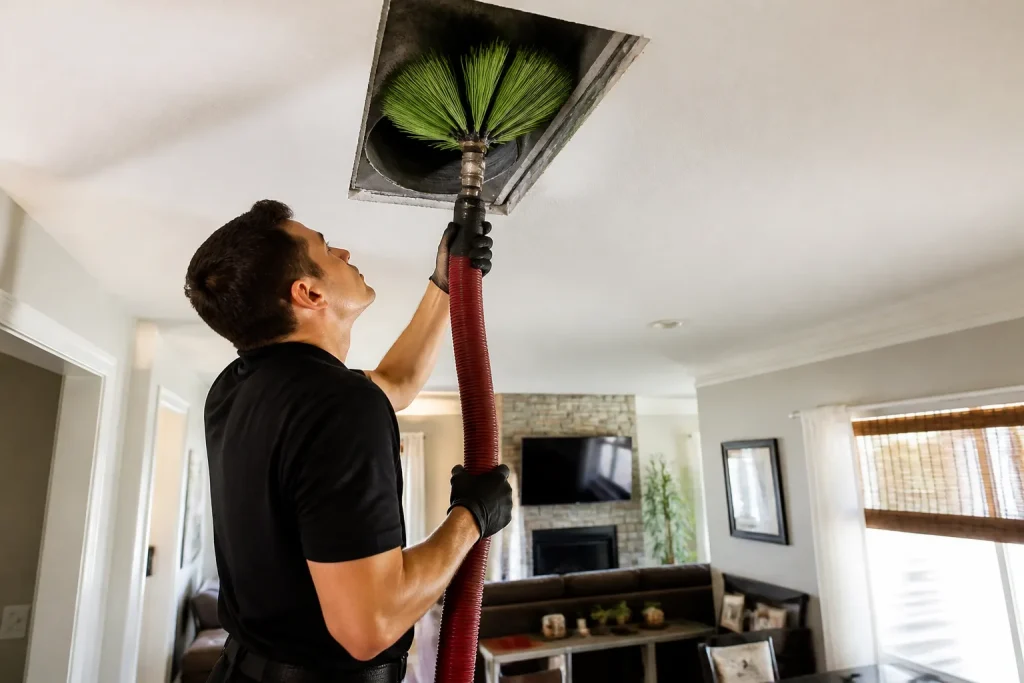
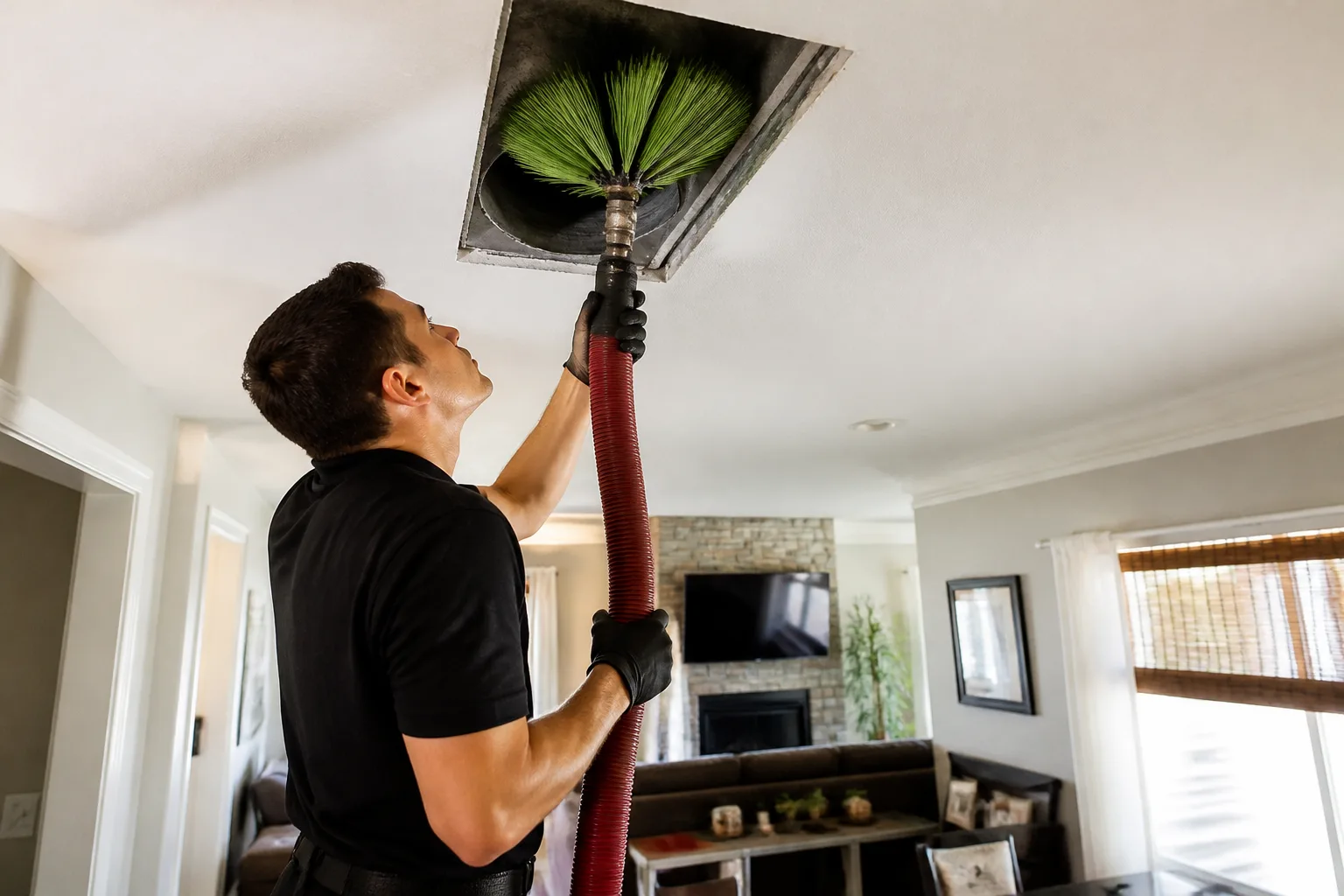
A proper negative-air cleaning in a Los Angeles home typically involves cutting an access point into the supply and return plenums, connecting the vacuum hose, sealing other registers, and then using agitation tools, either pneumatic or rotary brush systems, to dislodge debris stuck to the duct walls. Here is what should happen after the job is done:
- 1
The internal surfaces of the supply and return ducts should be visibly free of dust films and debris when photographed.
- 2
The furnace or air handler interior, including the blower motor housing and evaporator coil, should be cleaned if it has accumulated contamination.
- 3
Any access holes cut during the process should be properly patched and sealed, not left with a loose metal patch and duct tape.
- 4
You should receive before-and-after photos of your actual ductwork, not stock images from a marketing folder.
We pulled a shop vac out of a garage over in Silver Lake a few years back, and the homeowner honestly believed that qualified as a thorough duct cleaning. It does not. The equipment has to generate enough airflow, measured in cubic feet per minute, to overcome the static pressure of your particular duct layout, and the technician has to know how to set up the pressure differential correctly. A Nikro machine in the wrong hands is just an expensive fan.
Why Technician Training Matters More Than The Brand On The Machine
The single biggest problem in the air duct cleaning industry, in Los Angeles and everywhere else, is not the equipment. It is the gap between what the machine can do and what the person running it knows how to do. A NADCA ACR certification, which stands for Air Systems Cleaning Specialist, is the recognized credential for residential duct cleaning. It requires passing a written examination and documenting hands-on field experience. That certification is about the technician’s knowledge of airflow physics, contamination remediation, and proper access point placement, not about any machine brand.
Here is a real Los Angeles example. Older homes in neighborhoods like Los Feliz, West Adams, and the San Fernando Valley often have flexible ductwork installed during renovations in the 1970s through the 1990s. That flex duct has a thin plastic inner liner that can tear if an aggressive rotary brush system is pushed through it too fast or at the wrong angle. A technician who has trained on older LA housing stock knows to slow down, check for existing tears, and use lower-torque agitation methods when needed. A technician who just bought a Nikro vacuum because the brochure looked good might not know any of that, and now you have a torn duct liner and a new air leak, and the cleaning job just created a repair bill. This is the kind of thing that separates a professional from a guy with a machine, and it is exactly why we screen for training and on-the-ground experience, not gear specs alone.
When to call a pro: if your ducts have not been cleaned in more than five years, if you have pets and visible dust accumulation around your vents, if anyone in your home has unexplained allergy symptoms, or if you recently completed a renovation in a Los Angeles home that generated drywall dust. Those jobs are not DIY friendly. The access requirements alone make them a two-person job with professional equipment.
Three Questions To Ask Any Company Advertising “Nikro Air Duct Cleaning”
You want to separate genuine capability from marketing language. Here are three direct questions to ask any company that references Nikro in their advertising, and what solid answers sound like.
Question 1: Are your technicians NADCA ACR certified, and can I see proof before the job starts?
A confident answer is yes, with a certification ID and a willingness to show it at the door. A weak answer is deflection, an offer to “get back to you,” or a vague claim about “on-the-job training.” There is no substitute for the credential. Training hours on the machine alone are not a cleaning standard. In Los Angeles, where so many homes are older and ducts are layered with decades of dust, the credentials should be non-negotiable.
Question 2: What is your process for setting up negative pressure, and will I see before-and-after photos of my own ducts?
A solid company tells you exactly where they will cut the access point, how they will seal the registers, and how they will verify that the pressure differential held during the job. They also offer photos. If a company will not commit to photographic evidence of your own ductwork before and after cleaning, ask yourself how you will know the job was actually done. This is our standard practice on every Air Duct Cleaning in Los Angeles job, and it is a reasonable expectation for any contractor.
Question 3: Does this price include access point creation, sealing, and re-insulation, or are those separate line items?
This is the question that exposes surprise invoice territory. Some companies advertise a base cleaning price that covers the vacuum work only, then charge extra for access points, for patching, for coil cleaning, for everything that is actually required by a legitimate NADCA-compliant job. In Los Angeles, a straight answer sounds like: one flat price per system, written down before work begins, covering everything required to do the job properly. That is the standard we hold at Linden Air Duct Cleaning home, and it is the answer you should expect from any reputable company. Avoid any company that quotes per-vent pricing or a teaser number over the phone. That is a red flag.
What Nikro Equipment Does Well (And When It Is Not Enough)
To be clear, we are not knocking Nikro. The company builds solid machines. Their negative air units have strong suction, good HEPA filtration, and they are built to run all day, which matters when you are doing multiple Los Angeles jobs in a single week. We have used Nikro equipment on jobs in the San Fernando Valley where the ductwork was packed with plaster dust from a 1980s renovation, and the machine handled it without choking. We also work with professional-grade equipment from Rotobrush and air-quality products from Honeywell and Aprilaire, depending on the job type. The tool is part of the job, but it is not the job.
What Nikro does not do is clean your ducts by itself. The machine creates the pressure differential that makes source removal possible, but the technician still has to open the system correctly, agitate the duct walls, clean the registers, clean the blower and coil if needed, and seal everything back up properly. In hot, dry Los Angeles summers, the fine particulate that collects in ductwork is often a mix of outdoor pollutants, construction dust, and pet dander. That material does not just fall out because the vacuum is running. It has to be physically loosened and extracted. If the company you are evaluating talks only about the machine and never about the process, keep looking.
How Much Should Nikro-Compatible Duct Cleaning Cost In Los Angeles?
Let’s talk numbers. You came here because you probably searched for a specific thing, and the honest answer is that the equipment brand does not change the cost much. A thorough, whole-home air duct cleaning in Los Angeles, including access point creation, negative-pressure setup, agitation, coil cleaning if needed, and professional sealing, typically runs between $450 and $1,200. Smaller homes with simple duct layouts land on the lower end. Larger houses in areas like Sherman Oaks or Manhattan Beach, or homes with heavily contaminated systems, land on the higher end. Here is a realistic breakdown of the parts of the job you should see in a written quote.
| Task | Typical Los Angeles Price Range | What It Covers |
|---|---|---|
| Whole-home duct cleaning (up to 12 vents) | $450 – $750 | Supply and return duct cleaning, register cleaning, negative-pressure extraction |
| Additional vents / access points | $25 – $50 per vent, $75 – $150 per access | Extra zones or hard-to-reach sections of ductwork |
| Furnace air handler / blower cleaning | $150 – $300 | Blower motor housing, fan blades, internal cabinet |
| Evaporator coil cleaning | $200 – $450 | Coil cleaning, often required for real efficiency gains |
| Dryer vent cleaning | $100 – $200 | Separate service; see our Dryer Vent Cleaning in Los Angeles page |
Here is the part we want to flag for every Los Angeles homeowner: some companies will quote you a very low number over the phone to get on the schedule, then the technician arrives and suddenly the job requires extra access fees, extra vents, extra coil work. That is the industry’s bait-and-switch reputation, and it is earned. The answer is to ask for a written price before any work begins, and to read the line items. At Linden Air Duct Cleaning, the written price before work starts has been our standing practice on every job since we started serving Los Angeles in 2004, and it is not a promotional offer. It is the way the job should always work.
What LA Homeowners Should Know About Their Duct Systems
Los Angeles housing stock is not uniform, and the condition of your ductwork depends a lot on when your home was built and what has happened inside it since. Homes built before 1960 often have fewer return registers, which means less air circulation and more dust settling inside the supply ducts. Homes renovated in the 1980s and 1990s commonly have flex duct that ages poorly, and in neighborhoods like Atwater Village or Leimert Park, we have seen flex duct that literally crumbles when touched. Newer homes in the Valley or on the Westside generally have better-sealed systems, but even a properly sealed duct system in Los Angeles will accumulate fine dust over five to seven years, especially if you run your HVAC year-round for the warm season, leave windows open on cool evenings, or have pets.
The point here is that your duct system is a specific thing, in a specific house, in a specific part of Los Angeles, and any company that gives you a price without looking at the system is guessing. A real professional looks at the duct layout, the access points, the filter condition, and the contamination level before quoting a firm number. There is no equipment brand, Nikro or otherwise, that changes that reality.
The Bottom Line
Nikro is a legitimate equipment manufacturer, and their negative air machines and vacuum systems are used by serious duct cleaning companies in Los Angeles and across the country. But “Nikro air duct cleaning” is not a service category, a certification, or a standard. It is a piece of hardware. The real indicators of quality are technician training, NADCA ACR certification, experience with LA’s older flex-duct systems, a clear negative-pressure process, before-and-after photos of your actual ductwork, and a written flat price before any work starts. Ask the three questions above, and you will quickly separate the professionals from the marketers. If you’re in Los Angeles and need help, Linden Air Duct Cleaning offers free estimates. Call (980) 447-2498 and you will speak to a live person who can give you straight answers.
Related services in Los Angeles: Air Duct Cleaning, Dryer Vent Cleaning, and Air Duct Repair.
Frequently Asked Questions
Is Nikro air duct cleaning a certification or standard?
No. Nikro Industries is a manufacturer of negative air machines and HEPA vacuum systems. A company advertising “Nikro air duct cleaning” is telling you which equipment they own, not that they hold a recognized cleaning certification. Look for NADCA ACR certification and documented training instead.
How much does Nikro air duct cleaning cost in Los Angeles?
Most whole-home air duct cleanings in Los Angeles cost between $450 and $1,200, regardless of the equipment brand used. The range depends on home size, number of vents, access difficulty, and contamination level. A written flat price before work begins is the standard you should demand. Call (980) 447-2498 for an exact quote; estimates are free.
Does the brand of duct cleaning equipment really matter?
Quality equipment matters because it must generate enough negative pressure to pull debris from the system without contaminating your living space. But a trained technician with a basic setup will do a better job than an untrained operator with top-tier equipment. The skill of the person running the machine is always more important than the name on the machine.
How do I know the duct cleaning was actually done?
Ask for before-and-after photos of your own ductwork. A legitimate cleaning company will document the interior of supply and return ducts and show you the difference. If a company will not provide photographic evidence, consider that a red flag. You should also ask about access point placement and sealing, since those details reveal whether the job was set up properly.
Written by Marcus Veale, Owner at Linden Air Duct Cleaning, serving Los Angeles since 2004.
Need Air Duct Cleaning Help?
Call Linden Air Duct Cleaning - licensed & insured, here with fast after-hours help in Los Angeles.
(980) 447-2498