
Air Duct Cleaning: Repair or Replace? How Los Angeles Homeowners Decide
Most Los Angeles homeowners ask the wrong question first. They call a duct cleaner who says “you need cleaning,” or an HVAC contractor who says “you need replacement,” and neither has an incentive to tell you the truth. The right question is simpler: what condition are your ducts actually in? Repair makes sense when damage is localized and the duct material is still holding up. Replacement becomes the only logical choice when the duct system has passed its serviceable life, typically 20 to 30 years for flex duct. Cleaning, meanwhile, is correct when the ducts are structurally sound but carrying a heavy load of dust, debris, or biological growth. If you’d rather not figure this out alone, call (980) 447-2498 and we’ll walk you through it.
We’ve been at this in Los Angeles, and we can tell you that the repair-or-replace decision has a distinctly local flavor here. LA’s housing stock skews older, our air runs dry and dusty, and a huge number of homes built between 1970 and 1995 came with flex duct that was never designed to last this long. That reality changes the math. Here’s how to work through it.
The Three Conditions Where Cleaning Is the Right Call
Cleaning is a maintenance task, not a fix. It removes accumulated material from ducts that are otherwise healthy, and it’s the right call in Los Angeles when any of these three conditions apply.
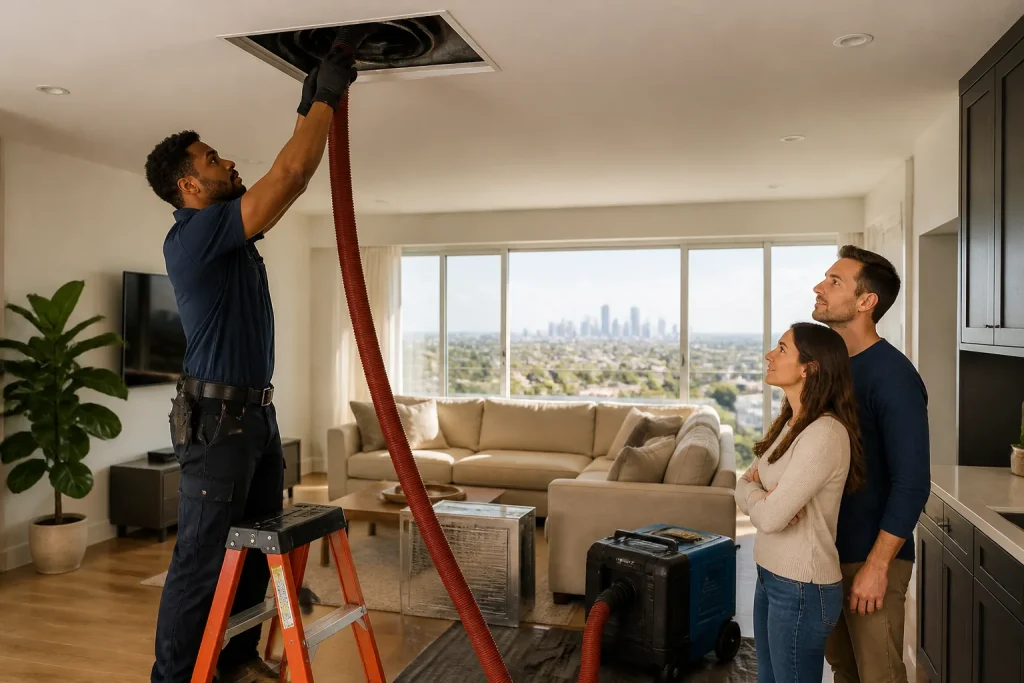
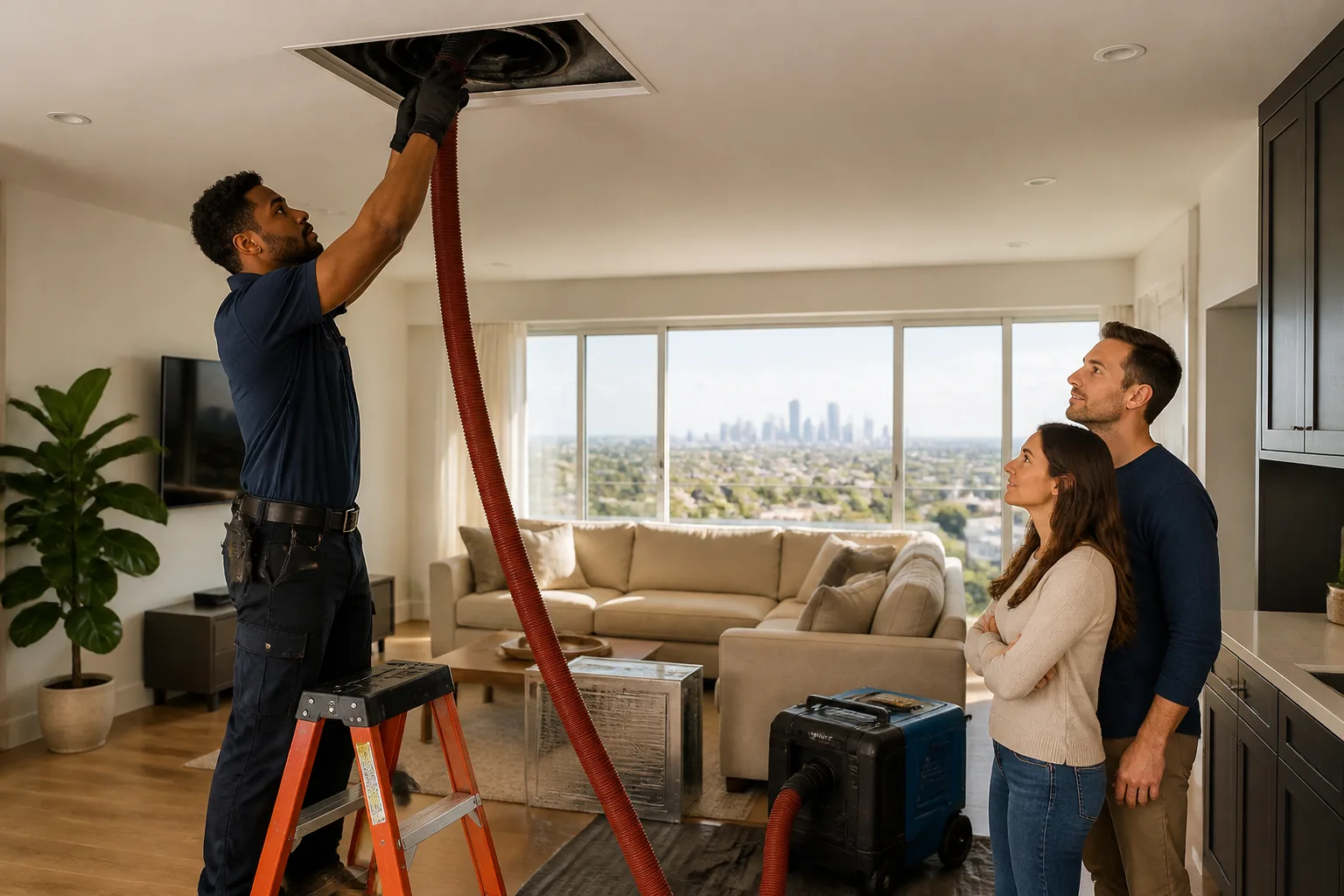
First, visible dust and debris accumulating at registers. If you wipe a vent grille and it’s dark again within a week, or you see dust piling up around the vent openings themselves, your ducts are carrying particulate. This is exactly what air duct cleaning in Los Angeles addresses. The fix is mechanical removal using negative-pressure extraction, which is the trade’s term for pulling air backward through the system at high volume while agitating the duct walls to release what’s stuck to them. In plain English: we hook a powerful vacuum to your duct system and loosen the debris so it gets pulled out rather than pushed into your living space.
Second, the ducts are less than 15 years old and made of flex duct that’s still pliable. Flex duct has an inner plastic liner, an insulation layer, and an outer vapor barrier. When it’s young, that liner is smooth and intact, which means cleaning won’t tear it. If your home was built or its HVAC system replaced after roughly 2010, and you have no signs of physical damage, cleaning is almost always the most cost-effective first step.
Third, you have documented biological growth but no duct deterioration. In Los Angeles, this typically shows up as a musty smell that kicks on when the AC starts, or visible mold on the inside of a register boot. A proper cleaning with antimicrobial treatment, using products like those from Abatement Technologies, can address surface growth on the duct walls. The catch: if the growth has penetrated the duct liner or insulation, cleaning won’t solve it, because you can’t fully disinfect porous material that’s breaking down.
The Three Conditions Where Repair Is the Right Call
Repair is the in-between option that too many Los Angeles homeowners never get offered. Here’s when it’s the correct call.
First, a localized tear or separation in one or two duct runs. Flex duct joints can pull apart, especially in attics where Los Angeles summer heat reaches 130°F to 150°F and the duct connectors expand and contract repeatedly. If you have one cold bedroom in a house where every other room cools fine, there’s a good chance a duct run has separated somewhere between the plenum and the register. That’s a repair. Replacing the entire system for one bad connection would be like replacing your entire plumbing system for a single leaking fitting under one sink.
Second, crushed duct sections from something heavy being set on top of them. We pulled a duct out of an attic in the Fairfax district a few years back that had been flattened by a boxes of holiday decorations, reducing airflow by maybe 60%. The duct material itself was fine. The fix was to replace the crushed section, re-support the run, and seal the connections properly. Total repair cost was a fraction of what full replacement would have run.
Third, disconnected or unsealed register boots. The boot is the metal or plastic fitting that connects the duct to the vent grille in your wall, floor, or ceiling. Over time, the connection can loosen, allowing conditioned air to leak into the wall cavity or attic. You’ll feel weak airflow at the register and possibly see dust streaks on the wall around it. Re-sealing and re-securing the boot is a straightforward repair. In LA’s older homes, particularly those built before 1980, we see this constantly. If you need this kind of work, our air duct repair in Los Angeles service covers it, with a written guarantee on every repair and a free second visit if the fix doesn’t hold.
You can reasonably repair your ducts when the total damaged area represents less than roughly 15% to 20% of the system. Above that threshold, you’re chasing leaks one at a time, and the labor cost of repeated repairs starts approaching the cost of doing it right once. More on that below.
The Two Conditions Where Replacement Is the Only Logical Choice
Replacement is expensive, and we don’t recommend it lightly. But there are two situations in Los Angeles where continuing to repair a failing duct system is just throwing money into an attic.
First, flex duct that’s 25 or more years old and visibly deteriorating. Here’s what aging flex duct looks like: the outer vapor barrier gets brittle and cracks, the inner liner tears or develops pinholes, and the insulation collapses. If you can see silver foil backing peeling away from the duct, or if the ducts sag heavily between supports, the material is done. Los Angeles homes built between 1970 and 1995 are the big risk group here, because that era’s flex duct was often installed with lower-quality materials and in long, unsupported runs across hot attics. The failure mode is different from sheet metal systems: sheet metal rusts or separates at seams, but flex duct degrades everywhere at once. When the material itself is failing, no amount of cleaning or patching will restore it.
Second, when your energy bills show systemic leakage across the whole system. This is the one most homeowners miss. Here’s how to read the pattern: pull your last 12 months of electric bills. Look at the months when your AC runs hard, July through October in Los Angeles. If your cooling costs have risen 30% to 50% over the same period three or four years ago, and you haven’t changed your thermostat habits or added square footage, duct leakage is a prime suspect. A duct system that’s losing 30% of its conditioned air into the attic will make your AC work dramatically harder. At that point, replacing the ducts typically pays for itself faster than you’d think, especially with SoCal Edison rates where they are.
The honest framework: if your total duct leakage is above roughly 25% to 30% of system airflow, measured by a real diagnostic test, replacement is the only logical choice. Repairing 20 small leaks across a deteriorated system ignores the fact that the material has failed globally.
How to Read an Energy Bill for Duct Leakage Before Calling Anyone
Before you spend a dollar on cleaning, repair, or replacement, do this. It takes 20 minutes and it tells you more than any contractor’s visual inspection will.
Go to your utility account, whether it’s SCE or LADWP. Download the last 24 months of billing data. Now compare cooling-season usage, June through September, against the same months from two years ago. Adjust for any known changes: a new baby means more AC, a new thermostat setting means usage shifts, working from home means the system runs more. But if none of those have changed and your kWh usage is up 40% or more during cooling months only, that’s a pattern that points to duct leakage, not an aging compressor.
Why cooling months only? Because in Los Angeles, the largest driver of duct leakage loss is conditioned air escaping into a hot attic. When the temperature difference between the duct air and the attic air is huge, which it is on a 95°F August day in the Valley, the energy penalty is proportionally larger. In winter, when your furnace runs less and the attic is cooler, the penalty shrinks. A bill increase that tracks heat waves is a duct problem. A bill increase that’s consistent year-round points to the equipment itself.
This is the kind of analysis that most companies won’t walk you through before quoting a service. They want to sell you their thing. We’d rather have you know what you’re looking at first.
What a Proper Diagnostic Inspection Looks Like
When you do call a professional, whether it’s us or another company, you need to know the difference between a sales walk-through and a diagnostic inspection. Here’s what a proper one includes.
Visual inspection through access points, not just at the registers. A technician should look inside the duct runs, not just at the vent grilles. That means opening a supply plenum, inspecting at least several duct branches, and checking the return side. If someone spends 20 minutes walking around your house looking at vent covers and then gives you a quote, that’s not a diagnostic.
Duct pressure testing. This is the gold standard for measuring leakage. The technician seals the registers and uses a calibrated fan to pressurize the duct system, then measures how much air escapes. The result is a leakage number, typically expressed as a percentage of total airflow or in CFM at a given pressure. This tells you objectively whether you’re looking at a repair situation or a replacement situation. In Los Angeles, older homes routinely test at 30% to 50% leakage, which means replacing the ducts typically pays for itself within a few years.
Airflow measurement at each register. A technician using an anemometer or flow hood can measure actual airflow per room and compare it to what the room should be getting based on its square footage. Discrepancies in specific rooms point to specific problems. A systemic shortfall across every room points to the whole system.
If a company quotes you a cleaning, repair, or replacement without doing at least some of this testing, ask why. There are legitimate cases where a visual inspection is sufficient, but the answer should be logical, not “we charge for that separately.” Our own technicians at Linden Air Duct Cleaning use professional-grade diagnostic tools alongside our Rotobrush cleaning equipment, and we’ll tell you plainly whether cleaning is worth your money or whether you’re looking at a structural issue.
The Cost Comparison Framework for Los Angeles Homeowners
Here’s what you can expect to pay in the Los Angeles market, as of early 2026. These are whole-system ranges, not per-vent teaser pricing.
- Full air duct cleaning on a typical 1,500 – 2,500 square foot LA home: $450 – $900, depending on system size, number of returns, and whether there’s biological treatment involved.
- Localized duct repair, such as reconnecting one separated flex run, replacing a crushed section, or re-sealing a handful of register boots: $300 – $1,200, depending on access difficulty (attic vs. crawl space) and materials.
- Full duct replacement on the same size home: $3,500 – $8,000, varying with duct material, insulation R-value, system configuration, and attic accessibility.
The decision framework we give our customers is this: if the system is less than 15 years old and shows no structural damage, clean it. If the system is 15 to 25 years old and has isolated damage, repair the damage and clean the rest. If the system is over 25 years old and showing systemic leakage or material failure, replace it.
One more consideration that most companies won’t mention: the remaining lifespan of your HVAC equipment. If your furnace and AC are 15 years old and likely to be replaced within five years, it often makes sense to do duct replacement at the same time as the equipment change, because the labor overlaps. If your equipment is newer, repairing ducts now and replacing them later means paying for labor twice. It’s not a small consideration, and in Los Angeles where HVAC systems work hard from May through October, it matters.
Related Services in Los Angeles
If you’re working through this decision, you may also want to look at two related services we offer. Dryer vent cleaning in Los Angeles addresses a different system entirely, the exhaust from your clothes dryer, but it’s worth doing on the same visit if you’re already having us out. And if you’ve determined that your ducts are in good shape but simply dirty, our Linden Air Duct Cleaning home page explains exactly how our cleaning process works, what it costs, and what you should expect before, during, and after the job.
What happens when you call
- 1
A real person answersNo phone trees - you reach a local pro.
- 2
You get an upfront price rangeHonest numbers before anyone is dispatched.
- 3
A background-checked tech heads outLicensed & insured, dispatched right away.
- 4
You approve before work beginsNothing starts until you say go.
The Bottom Line
The repair-or-replace decision comes down to three questions in this order: How old is your duct material? Is the damage localized or systemic? And what does your energy bill say? Answer those three questions honestly and you’ll know the right call before anyone gives you a quote. If you’re in Los Angeles and want a second set of eyes on it, we offer free estimates with no obligation. Call (980) 447-2498 and we’ll talk through what you’re seeing. What we won’t do is push a cleaning when you need a repair, or a repair when you need a replacement. That’s not how we’ve done business, and it’s not how we’ll do business tomorrow.
Frequently Asked Questions
Check the age and condition of your duct material first. If your ducts are less than 15 years old and there’s no visible damage, cleaning is almost always the right call. If you see tearing, crushing, separations, or deteriorating flex duct, you’re looking at repair or replacement. A diagnostic inspection with pressure testing will give you the definitive answer. Call (980) 447-2498 if you want us to evaluate it, estimates are free.
Deteriorating flex duct in homes built between 1970 and 1995. The materials used in that era degrade in Los Angeles heat, becoming brittle and leaking conditioned air into the attic. This shows up as high cooling bills and rooms that never quite reach the thermostat setting, even when the AC is running constantly.
Full duct cleaning on a typical LA home runs $450 – $900. Localized duct repair typically costs $300 – $1,200. Full duct replacement runs $3,500 – $8,000. The decision should be based on duct age and leakage test results, not the price difference alone. Call (980) 447-2498 for an exact quote on your specific system.
Only if the increased bill is caused by accumulated debris restricting airflow, which is relatively rare compared to leakage. A sharply higher cooling-season bill usually points to duct leakage or equipment degradation, not dirt. A pressure test will tell you which one you’re dealing with before you pay for any service.
Written by the team at Linden Air Duct Cleaning.
Need Air Duct Cleaning Help?
Call Linden Air Duct Cleaning - licensed & insured, here with fast after-hours help in Los Angeles.
(980) 447-2498