
Dryer Vent Cleaning: Repair or Replace? How Los Angeles Homeowners Decide
The short answer: if your dryer vent is the right material, under 25 feet, and runs straight to an exterior wall, cleaning usually solves the problem. If the duct is old foil accordion, crushed behind the dryer, longer than code allows, or venting into an attic or crawlspace, no amount of cleaning will make it safe. In Los Angeles, where thousands of homes predate current California mechanical code, that second scenario is far more common than most people realize. So before you pay for a cleaning, you need to know which situation you’re actually in. If you’d rather not sort through this yourself, call (980) 447-2498 and we’ll walk you through it.
What Most Dryer Vent Companies in Los Angeles Won’t Tell You
The dryer vent industry has a dirty secret, and we say that as people who clean dryer vents for a living. A standard cleaning removes lint from the inside of the duct. What it can’t do is fix the duct itself. And in LA, the duct itself is frequently the problem.
Homes built in the San Fernando Valley, West Adams, and older pockets of Long Beach before roughly 1990 often have one of three things hiding behind the laundry wall: foil accordion duct, white vinyl flex, or a run that bends through interior walls because the laundry room sits in the middle of the house. Foil and vinyl were common building materials at the time. They’re also flammable, they trap lint at every ridge, and current California mechanical code flat-out prohibits them for dryer exhaust. A cleaning will pull out the lint that’s there today. It won’t change the fact that the material itself is waiting for the next load of laundry to re-clog it, or worse.
This is the information gap that drives the repair-or-replace decision. Most cleaning companies in Los Angeles won’t flag these issues because they only sell cleaning. We’re different, and we’ll explain why below.
Cleaning Is the Right Call When These Five Things Are True
We clean a lot of dryer vents every month, and we’re happy to tell a homeowner their vent is fine and just needs routine maintenance. That happens when all five of these conditions hold:
- The duct is rigid metal or semi-rigid metal. Smooth interior walls move lint through efficiently instead of trapping it. Aluminum is the standard.
- The total run is 25 feet or less. That’s the maximum length allowed by California code before you need to account for bends. Every 90-degree elbow subtracts 5 feet from your allowed total.
- The vent terminates outside the house. Not into the attic, not into a crawlspace, not behind the dryer. It needs to end at an exterior wall or roof cap with a working backdraft damper.
- The exterior flap opens fully during operation. If it’s stuck half-open or painted shut, that’s a repair issue, not a cleaning issue.
- Your dryer is getting the job done. Clothes come out dry in one normal cycle. The laundry room doesn’t feel like a sauna after 40 minutes.
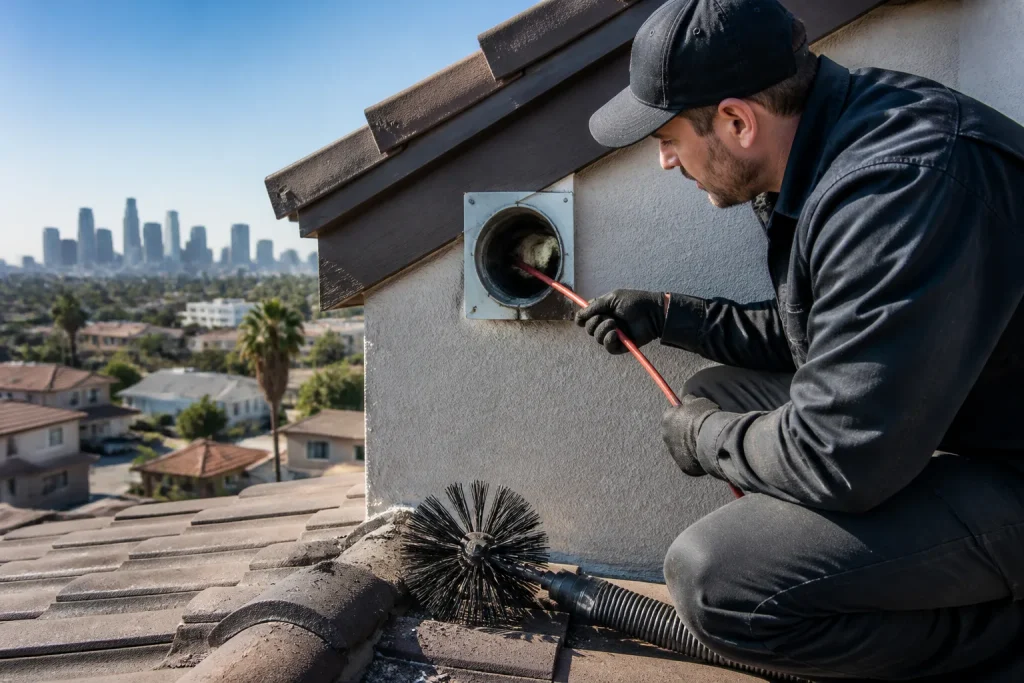
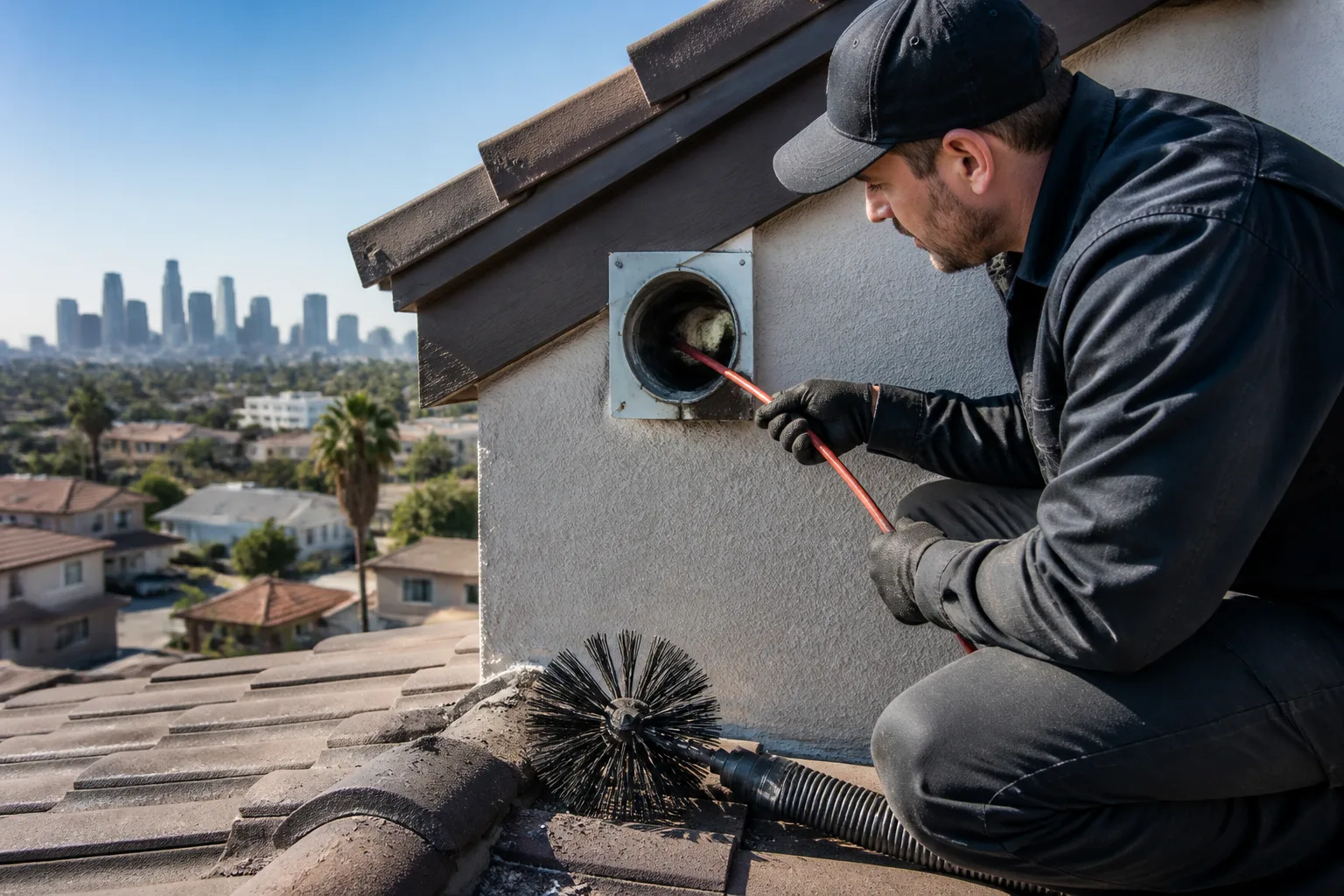
When all five check out, a professional cleaning is the right move. We use negative-pressure extraction with Rotobrush equipment, which pulls lint out of the full run rather than just pushing it around. For most LA households, that’s a once-every-12-to-18-months job. But here’s the key: a proper inspection happens before the cleaning, not after. If we find a code violation, we tell you before we clean, because cleaning a fire hazard doesn’t remove the hazard.
When the Vent Itself Is the Problem: Five Conditions That Demand Repair or Replacement
Now let’s talk about the situations where cleaning is either useless or actively dangerous. We’ve listed them by what we actually see in Los Angeles homes, from most to least common.
1. Foil accordion or vinyl flex duct
If your dryer vent looks like a slinky wrapped in aluminum foil, that’s foil accordion. It’s the single most common fire hazard we find in pre-1990 LA homes. The ridges catch lint, the material can sag and trap moisture, and it’s explicitly banned in California for dryer exhaust. Replacement with rigid metal is the only correct fix. This is not a gray area.
2. The vent terminates inside the house
We pulled a vent out of a garage in North Hollywood last month that dumped directly into the wall cavity between two stud bays. The homeowner had been running it for six years. The lint buildup inside that cavity was thick enough to insulate a wall. This happens more than anyone wants to admit, especially in converted garages and added-on laundry rooms where someone took a shortcut. The fix is a re-route, always.
3. Crushed or kinked duct behind the dryer
When the dryer gets pushed against the wall, the flexible connector often crushes on itself. You lose airflow instantly. The dryer runs longer, the exterior flap barely moves, and lint settles into every available crevice. Sometimes this is a simple re-routing and a shorter connector. Sometimes it means moving the dryer’s gas line or outlet. We’ll tell you which before we touch anything.
4. Run length over 25 feet with multiple bends
Code says 25 feet, minus 5 feet per 90-degree elbow. An LA laundry room tucked into a hallway closet often has a run that goes over, under, and around plumbing. Twenty-five feet becomes illegal fast. The answer is either a booster fan (if the run is still reasonable) or a full re-route to a shorter termination point. We’ve done both, and the price difference between them matters, which we’ll get to.
5. Your drying time is climbing, and you’ve already cleaned recently
If you paid for a cleaning six months ago and your dryer is back to taking two cycles per load, the cleaning wasn’t the problem. Something about the vent system is causing lint to re-accumulate at abnormal speed. Usually it’s one of the four conditions above.
What a Proper Dryer Vent Inspection Includes (Beyond Lint Removal)
We don’t think an inspection is a sales pitch with a flashlight. When we inspect a dryer vent in Los Angeles, we check four specific things, in this order:
- Termination cap condition. The flap should open fully against gravity, the louvers shouldn’t be painted over, and the cap body shouldn’t be rusted through. A broken cap lets birds in, and birds bring nesting material. We’ve removed nests in Silver Lake more times than we can count.
- Airflow measurement. We use an anemometer at the termination point. A healthy dryer vent moves air at a specific velocity, and when the number is low, we know there’s a restriction somewhere, even if the visible lint looks manageable.
- Duct material verification. We physically identify what the duct is made of. If it’s anything other than rigid metal or approved semi-rigid, it’s a replacement, not a cleaning.
- Run-length assessment. We estimate the run, count the bends, and determine whether the installed configuration meets California mechanical code. If it doesn’t, we show you the numbers and explain the options.
That’s the minimum standard for a real inspection. If a company in Los Angeles quotes you a cleaning price before they’ve seen any of these things, you’re dealing with a cleaning mill, not an inspection.
What happens when you call
- 1
A real person answersNo phone trees - you reach a local pro.
- 2
You get an upfront price rangeHonest numbers before anyone is dispatched.
- 3
A background-checked tech heads outLicensed & insured, dispatched right away.
- 4
You approve before work beginsNothing starts until you say go.
Cost and Disruption: Cleaning vs. Partial Repair vs. Full Re-Route in Los Angeles
Let’s talk money, because that’s what actually drives the decision. These are realistic whole-system price ranges for the LA market in 2026, not teaser numbers designed to get a technician in your driveway.
| Service | Typical LA Price Range | Time on Site | Disruption |
|---|---|---|---|
| Professional dryer vent cleaning | $150 – $300 | 1 – 2 hours | Minimal. Washer and dryer stay in place. |
| Partial repair (cap replacement, accessible section swap) | $350 – $700 | 2 – 4 hours | Moderate. Dryer may need to move a few feet. |
| Full re-route (new rigid duct to new termination point) | $800 – $1,800 | 1 – 2 days | Higher. Involves wall or ceiling openings, patching, and sometimes exterior stucco work. |
Here’s what we tell every homeowner in Los Angeles who’s weighing these options. A cleaning at $150 – $300 is a maintenance expense. A re-route at $1,200 is a one-time fix that permanently removes the fire risk and the recurring cleaning problem. If your vent is foil accordion in a 1962 Valley ranch house, you can pay us $200 to clean it every year. Or you can pay $1,200 once and never think about it again. We’ll happily sell you the cleaning, but it’s our job to tell you the truth first.
One thing that separates us from most LA duct companies: the price goes in writing before any work starts, every time. No per-vent upsell, no surprise line items on the invoice. You’ll know the exact figure before we bring equipment into your home. And every repair carries a written Done Right Promise. If a covered repair doesn’t hold, we come back at no charge. That’s not a special offer; it’s how we’ve operated.
What Homeowners Can Observe Themselves: Four Warning Signs and What They Mean
You don’t need special equipment to notice most dryer vent problems. Here’s what to look for, and what each sign actually suggests about the underlying issue.
Drying time is creeping up. If a standard cotton load used to take 45 minutes and now takes 75, airflow is declining. This can mean lint buildup, a crushed connector, or a run that’s too long for the dryer’s blower. Each of those has a different fix, so don’t assume it’s automatically a cleaning.
The exterior flap isn’t opening fully. Stand outside while the dryer runs on high heat. The flap should be visibly pushed open by the exhaust. A weak opening means a restriction somewhere in the line. A flap that doesn’t move at all means something is blocking the run or the cap is broken.
The laundry room gets hot and humid. Your dryer vents heat and moisture outside. If it’s venting into the room, that’s a serious problem. A properly vented dryer should not turn your laundry area into a steam room. Heat buildup also forces the dryer to work harder, which shortens its life.
Lint is appearing around the dryer or the vent connection. Lint escaping the duct means gaps, cracks, or disconnected joints. It also means the lint that’s escaping is the same lint that can ignite if it contacts the dryer’s heating element or motor. This is a repair call, not a cleaning wait-and-see.
We’ll say this plainly because we think it saves lives: the U.S. Fire Administration attributes 2,900 house fires every year to dryer vents. In Los Angeles, with our older housing stock and thousands of converted laundry rooms, the margin for error is thinner than in a new build with a code-compliant vent. If any of the signs above sound familiar, get an inspection.
When to Call a Professional in Los Angeles
Here’s our honest take: if your vent is rigid metal, under 25 feet, terminates outside, and your drying time is normal, you can delay. You don’t need to call anyone today. Routine cleaning every 12 to 18 months is enough.
But if you see any of the signals in the section above, call a professional who can actually fix what they find. That’s the key: many Los Angeles dryer vent companies can only clean. If your vent needs replacement, they’ll clean it anyway because that’s the only service they offer. You pay, the problem stays, and you’re no safer than you were before the appointment.
At Linden Air Duct Cleaning, every technician who arrives at your door is background-checked, identity-verified, and photo-badged. We send you the tech’s name and photo before the visit, and they show you a physical ID badge at the door. We call this the Threshold Standard, and it’s been our operating practice as part of the Threshold Group family. If you’re home alone, you’ll know exactly who’s walking up your driveway before they ring the bell.
We also work with trade-trusted equipment and products: Rotobrush and Nikro for extraction, and air-quality brands like Honeywell and Aprilaire when we’re addressing broader indoor air concerns. For related services in Los Angeles, see our Dryer Vent Cleaning in Los Angeles page for cleaning specifics, or our Air Duct Repair in Los Angeles page if the issue extends into the HVAC system. For a full breakdown of what our full home duct service covers, visit Air Duct Cleaning in Los Angeles.
The Bottom Line
The repair-versus-replace decision comes down to one question: what is your vent made of, and where does it go? If it’s rigid metal running a reasonable distance to an exterior wall, cleaning is a maintenance task, full stop. If it’s foil, vinyl, terminated indoors, crushed, or wildly over the code-limited length, cleaning won’t fix it and the only correct answer is repair or replacement. In Los Angeles, the age of our housing stock makes the second scenario the more common one. Don’t pay to clean what should be replaced.
If you’re in Los Angeles and not sure which camp you’re in, we’ll send someone out to look. The inspection is straightforward, the findings are documented, and the price goes in writing before anything happens. Call (980) 447-2498 for a free estimate, or learn more at the Linden Air Duct Cleaning home page.
Frequently Asked Questions
Cleaning is sufficient when the vent is rigid metal, under 25 feet, terminates outside, and the only issue is normal lint accumulation. Replacement is required when the duct is foil accordion or vinyl, terminated into an interior space, crushed, or over code length with multiple bends. We document all of these conditions during a standard inspection so you’re deciding with facts, not guesswork. Call (980) 447-2498 and we’ll assess your vent.
In Los Angeles, a partial repair like a termination cap replacement or an accessible section swap typically runs $350 to $700. A full re-route with new rigid duct, new termination point, and patching work usually lands between $800 and $1,800 depending on wall access and run complexity. At Linden Air Duct Cleaning, you’ll get a written price before any work begins, so there’s no surprise on the invoice.
You can remove visible lint from the lint trap and the first foot or two of connector duct. What you can’t do from the laundry room is assess the full run for hidden restrictions, verify the duct material behind the wall, or measure airflow at the termination point. Those require professional equipment and access. If your vent is rigid metal and you want to do basic maintenance, that’s reasonable. If your vent is anything else, a cleaning won’t change the material.
For a typical LA household using the dryer 4 to 6 times a week, a professional cleaning every 12 to 18 months is the right cadence. Households with large families, long vent runs, or pets that shed heavily may need it more often. If you’re drying time is creeping up well before the 12-month mark, something other than routine lint is at play. Call (980) 447-2498 and we’ll help you figure out what’s going on.
Written by the team at Linden Air Duct Cleaning.
Need Air Duct Cleaning Help?
Call Linden Air Duct Cleaning - licensed & insured, here with fast after-hours help in Los Angeles.
(980) 447-2498