
Spring Air Duct Cleaning Checklist for Los Angeles Homes
Spring air duct cleaning in Los Angeles is not about shaking off winter dust. It is the moment to remove what Santa Ana wind events, wildfire smoke, and winter rain humidity deposited inside your duct system between February and April and to verify that moisture has not started anything biological behind your registers. Most LA homes should book this work in May or early June, after pollen peaks subside. We’ve served Los Angeles homeowners since 2004, and the checklist below is organized around what actually accumulates here, not what a generic national template says to do.
If you would rather skip the inspection and have a professional handle it, call (980) 447-2498 for a free estimate. Otherwise, here is the room-by-room checklist we hand to friends.
Why Los Angeles Ducts Fill Up Faster Than Most Cities
Los Angeles pollen season peaks from February through April, which is also when Santa Anas push desert particulate and wildfire residue through every gap in a home’s envelope. By May, the average Los Angeles home’s duct system has filtered more airborne particulate in four months than homes in most U.S. cities see in a full year. Coastal neighborhoods like Santa Monica and Marina del Rey add salt-laden air. Valley communities like Encino and Sherman Oaks add fine dust from the 405 corridor and the Sepulveda Basin. Foothill areas like La Cañada and Pasadena add chaparral pollen and, after fire years, ash that clings to duct walls.
Winter rain adds a second variable. Ducts in raised-foundation homes pull moisture from the crawl space. Attic ducts in single-story slab homes sweat when hot afternoon air meets cooler morning air inside unconditioned attics. That combination of fine particulate plus moisture is precisely what turns inert dust into a biological concern by July if it is not removed in spring. The checklist below accounts for all of it.
Los Angeles-specific debris we routinely remove in spring:
- Santa Ana dust and fine silt that made it past the filter
- Wildfire smoke residue from the previous fire season
- Pollen from cypress, oak, olive, and grass bloom cycles
- Salt film and elevated humidity residue in coastal corridors
- Moisture-related spore growth triggered by winter rain, most often in crawlspace and split-level duct runs
Step 1: The Room-by-Room Register Inspection
Start with a visual pass of every supply register and every return. Remove the register cover, set it aside, and look inside the opening with a flashlight. This takes about 20 minutes in a typical Los Angeles home and tells you more than any single measurement. What you are looking for depends on the home type.
Single-story slab homes (common in the San Fernando Valley, Long Beach, Torrance, and most post-1960 LA tracts): duct runs sit in the attic. Look for fine gray dust caked on the register blades, which indicates Santa Ana silt. Check the return register for a dark filter-shaped outline on the wall or ceiling. That outline means unfiltered air has been bypassing the filter and pulling attic air into the system.
Raised foundation homes (West Adams, Los Feliz, Echo Park, and most pre-1950 construction): duct runs sit under the floor. Pull the register and check for moisture staining or any musty odor. After wet winters, we regularly find condensation inside subfloor ducts because the crawl space stays damp for weeks after the last storm. Look for rust on metal registers, which is a direct moisture signal.
Multi-story homes (Brentwood, Pacific Palisades, Studio City hillside homes): debris accumulates unevenly. Upstairs runs often carry more Santa Ana particulate because attic air is pulled in through the return path. Downstairs runs near the foundation can collect heavier material that falls out of the airstream. Compare upstairs and downstairs register interiors. If upstairs looks gray and fuzzy while downstairs looks relatively clean, the return duct is likely pulling attic air.
Step 2: Check for Moisture Intrusion Before Summer Heat
Los Angeles does not get a long rainy season, but the rain it does get lands between November and March, which means duct moisture problems created in February are still present in April and May. The goal is to catch them before summer heat accelerates whatever is growing.
Three checks matter. First, smell each supply register after removing the cover. Biological growth has a stale, humid, musty odor that is most noticeable when the system has been off for an hour. Second, look for visible staining on duct interiors near registers, especially on the metal boot that connects the duct to the floor or wall. Third, check the filter frame and the return duct for condensation marks or darkened areas.
Homes with evaporative coolers face an additional Los Angeles-specific issue: the cooler adds moisture directly to the airstream every summer. If March rains left residual moisture in the ducts and the homeowner switches on an evaporative cooler in June, the combination creates exactly the warm, humid environment that turns dust into a problem. Spring cleaning should happen before evaporative cooler season begins.
If you find moisture, do not chase it yourself. The cause could be anything from a cracked boot in a crawl space to a disconnected attic duct pulling unconditioned air. A professional can identify the source and correct it. If the fix requires repair, we cover that work under our written guarantee, which includes a free second visit if the repair does not hold.
Step 3: Document Everything With Your Phone Before Anyone Touches the Ducts
This is the single most useful step most homeowners skip. Before cleaning, take photos of the interior of at least six registers: two upstairs, two downstairs, and two returns. Use your phone’s flash. The goal is to create a baseline you can compare against next spring.
Photograph the filter as it sits, before removal, and photograph the area behind the return grille. If you see debris, moisture staining, or visible buildup, capture it. If the technician later tells you something was found, you will know whether it was visible before work began.
After cleaning, photograph the same six interior points from roughly the same angle. You are not looking for a spotless interior; even a freshly cleaned metal duct has dust residue within a week. What you are looking for is a visible difference: the thick, lint-like layer of material should be gone, and the interior surfaces should look dry and uniform. Those before-and-after photos become your home’s maintenance record, and they are what we’d ask you to reference next year when deciding whether another cleaning is justified.
In our experience, the homeowners who get the most from duct cleaning are the ones who take this extra ten minutes. You cannot evaluate what you cannot see.
Step 4: Replace the Filter After the Cleaning, Not Before
Most checklists tell you to replace the filter before the cleaning so the system starts fresh. That order is backwards. A dirty filter is evidence. The technician needs to see it to understand what has been bypassing the filter and entering the ducts. If you install a fresh filter before the service, you remove the single most informative clue in the entire system.
The correct sequence is this: leave the existing filter in place during the cleaning. Let the technician inspect it. After the ducts have been cleaned and the system has been run briefly to settle any disturbed particulate, then install a fresh filter. This order captures the dust that the cleaning loosened, instead of pushing it through a new filter and letting it damage the filter’s media or blow into the home.
Los Angeles homeowners should also know that filter quality matters more here than in most climates because of wildfire season. A pleated filter with a MERV rating between 8 and 11 captures smoke particulate reasonably well without choking most residential systems. Honeywell and Aprilaire make reliable products in this range. If you live in a fire-adjacent zone, ask us about higher-MERV compatibility before you buy; not every blower can handle the added resistance.
Step 5: Get a Written Confirmation of What Was Cleaned, Found, and Flagged
A service invoice is not enough. You need three things in writing, and most companies provide only the first:
- What was cleaned. Which duct runs were accessed, which returns were serviced, and whether the blower and plenum were included.
- What was found. Excess debris, moisture, biological growth, disconnected ductwork, damaged boots, pest intrusion, or anything else the technician observed.
- What was flagged. Items that were not repaired during this visit but that deserve attention within six to twelve months, so you can plan and budget for them.
At Linden Air Duct Cleaning, this is standard practice. We put the price in writing before any work begins, and we put the findings in writing after the work is complete. Every repair we perform is covered by a written guarantee. If the repair does not hold, we return at no charge. That is part of the 365-Day Done Right Promise, and it is written on every job, not just discussed on the phone.
We pulled a dryer vent duct out of a home in Sherman Oaks last spring where the homeowner had paid another company the year before. The system looked clean from the outside. Inside, the technician had never actually completed the run. That is why we tell every Los Angeles homeowner the same thing: if the company cannot tell you what it cleaned and what it found, in writing, you do not actually know what happened in your ducts.
When to Call a Professional in Los Angeles
You can complete Steps 1 through 3 on your own in about an hour. If what you find is straightforward dust accumulation with no moisture signals, and you are comfortable with basic HVAC maintenance, you may choose to wait. But call a professional if any of the following apply: you found moisture staining or a persistent musty odor, you see visible mold-like growth, you have asthma or significant allergies in the home, someone in the household is immunocompromised, you smell smoke residue months after a fire event, or you simply do not want to be on a ladder in an attic in Los Angeles in June. Attic temperatures in the San Fernando Valley routinely exceed 130 degrees by late spring, which is a safety issue by itself.
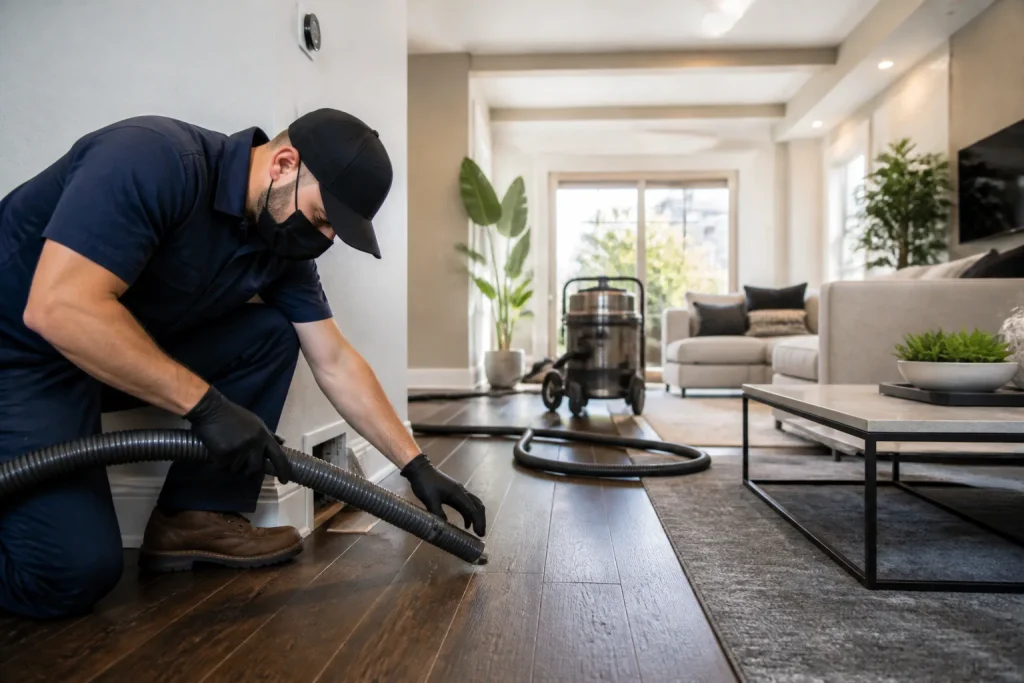
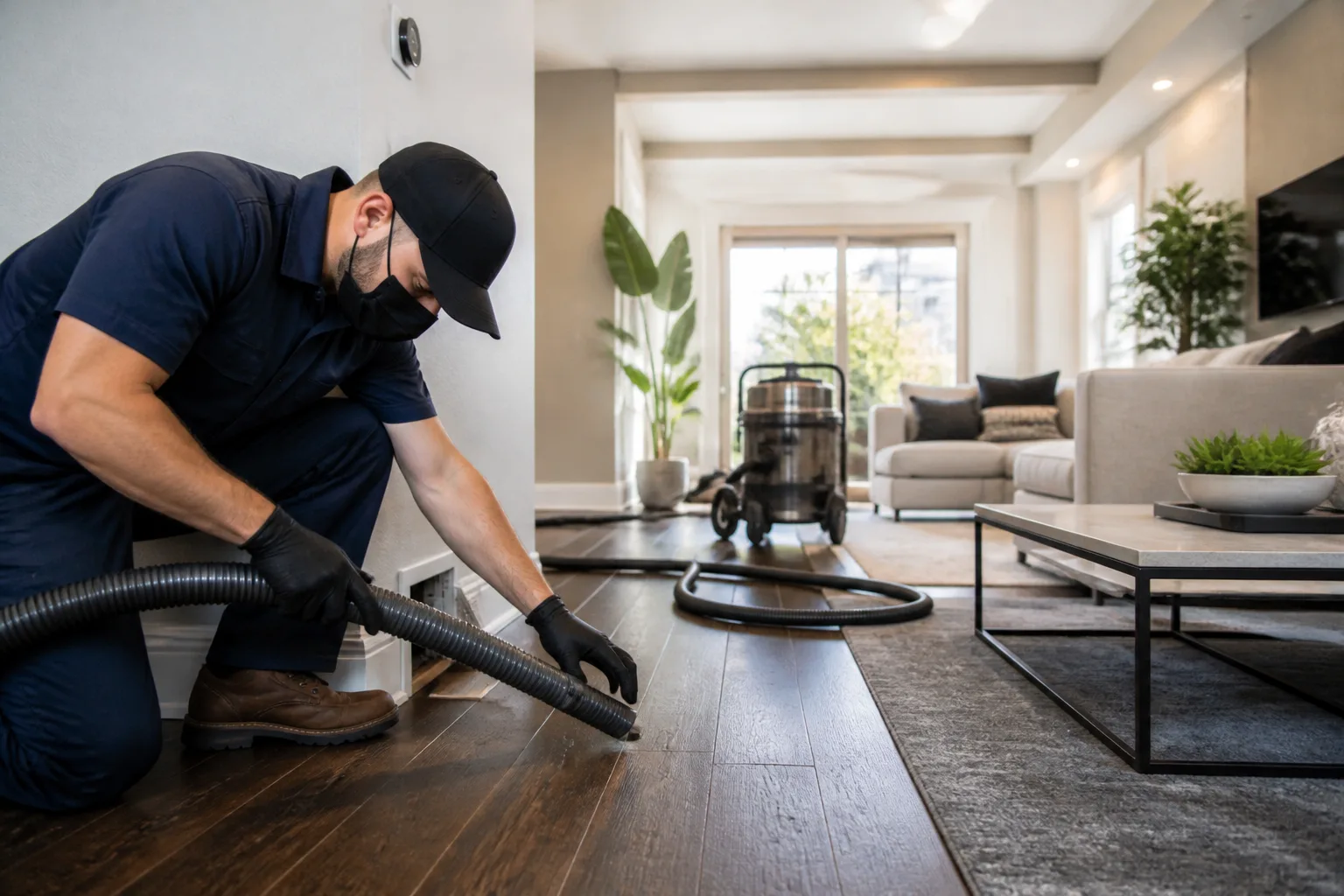
Professional duct cleaning uses negative-pressure extraction. A powerful vacuum connects to the duct system while air whips and compressed air dislodge material from the duct walls. The machine collects debris at the vacuum source, not inside the home. We run Rotobrush and Nikro equipment, both built for this purpose. We also carry air-quality products from Guardsman and Abatement Technologies for homes where the issue extends beyond the ducts themselves.
If you need related services, see our pages on Air Duct Cleaning in Los Angeles, Dryer Vent Cleaning in Los Angeles, and Air Duct Repair in Los Angeles. Our full approach is outlined on the Linden Air Duct Cleaning home page.
The Bottom Line
Spring air duct cleaning in Los Angeles is a post-allergy-season audit, not a routine dusting. The checklist that actually fits this city walks through: a room-by-room register inspection tailored to slab, raised foundation, and multi-story construction; a moisture check timed before summer heat and evaporative cooler season; phone documentation before and after; filter replacement after cleaning rather than before; and written confirmation covering what was cleaned, what was found, and what was flagged. Run those five steps in May or June and you will know exactly what is in your system, whether it matters, and what to do next.
If you would rather we handle it, Linden Air Duct Cleaning serves Los Angeles with written pricing before work begins, background-checked and photo-badged technicians under the Threshold Standard, and the 365-Day Done Right Promise on every job. Call (980) 447-2498 for a free estimate.
Frequently Asked Questions
For a typical single-family Los Angeles home, air duct cleaning usually runs between $350 and $650 for the full system, depending on home size, duct layout, and contamination level. We give a written price before any work begins, so you know the exact number before we start. Call (980) 447-2498 for a free estimate based on your home.
Most Los Angeles homes benefit from a professional duct cleaning every 3 to 5 years, not every year. The exceptions are homes in fire-adjacent zones, homes with pets that shed heavily, homes near major freeways like the 405 or the 10, and households with allergies. If you ran the checklist above and found heavy Santa Ana silt, moisture, or smell, it is probably time.
Your best proof is before-and-after photos of the same register interiors, taken by you or provided by the company, plus a written summary of which ducts were accessed and what was found. If a company refuses either, find another company. Our technicians will walk you through exactly what was cleaned and what they observed before leaving.
It can reduce the total particulate load in rooms where you spend the most time, especially after a heavy pollen season or a smoky fire year in Los Angeles. What it will not do is keep new particulate from entering through doors, windows, and the return path. We recommend duct cleaning alongside regular filter changes and, for persistent allergy symptoms, a conversation with your doctor about indoor air quality.
Written by Marcus Veale, Owner at Linden Air Duct Cleaning, serving Los Angeles since 2004.
Need Air Duct Cleaning Help?
Call Linden Air Duct Cleaning - licensed & insured, here with fast after-hours help in Los Angeles.
(980) 447-2498