
5 Mistakes to Avoid With Dryer Vent Cleaning
Most dryer vent cleaning mistakes aren’t about skipping the job entirely. They’re about doing it in the wrong order, with the wrong tool, or stopping at the wrong point, leaving the exact fire hazard the homeowner thought they’d eliminated. The U.S. Fire Administration attributes roughly 2,900 home dryer fires per year to failure to clean, but a cleaning done incorrectly can compact lint deeper into the vent line and make the hazard worse, not better. Here are the five mistakes we see most often in Los Angeles homes, and how to avoid them. If you’d rather not deal with any of this yourself, call Linden Air Duct Cleaning at (980) 447-2498 for a free estimate.
Key Takeaways
- Cleaning only from the interior pushes lint toward the exterior cap, where it can compact into a blockage.
- A leaf blower can’t break up hardened lint on long or multi-story vent runs.
- A crushed or kinked duct section must be fixed before cleaning, or the cleaning won’t hold.
- Airflow CFM testing at the exterior cap catches restrictions that a visual check will miss.
- Dryer vent cleaning and HVAC duct cleaning are separate jobs and should be scheduled separately.
Mistake #1: Cleaning Only From the Interior Laundry Room End
The logic sounds reasonable: push the lint out through the vent, same direction the dryer blows it. But here’s what actually happens on a typical Los Angeles vent run that travels through a wall, under a floor, or up through an attic. The lint you dislodge from the first few feet gets pushed downstream toward the exterior cap. If that cap has a screen or louvered damper, or if the run is long with a bend or two, the lint compresses into a dense plug right before the exit. You’ve moved the problem, not solved it.
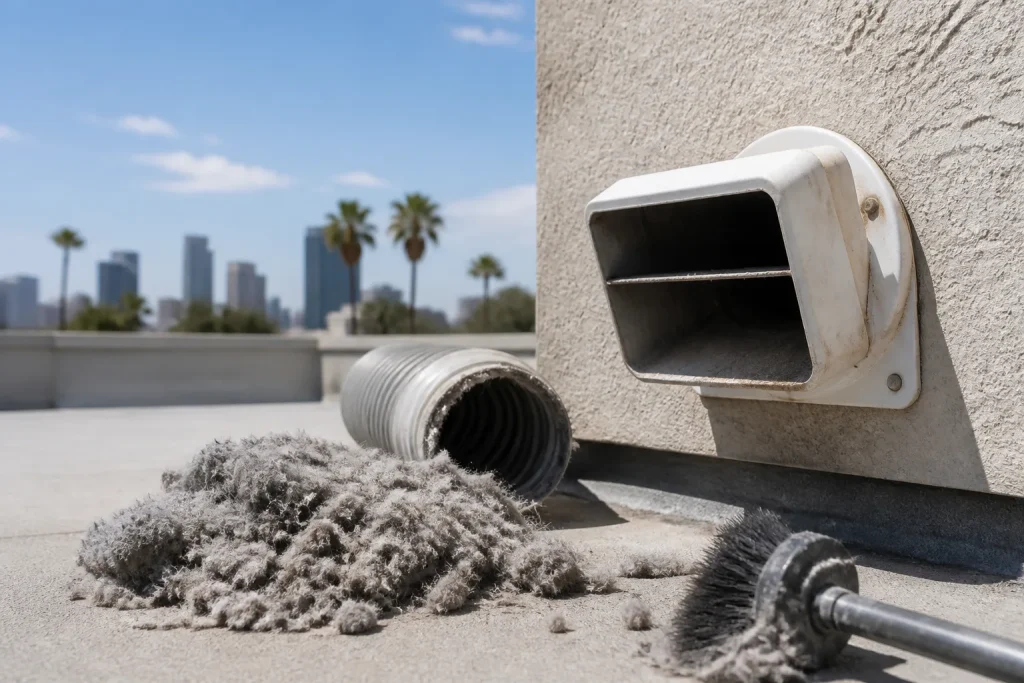
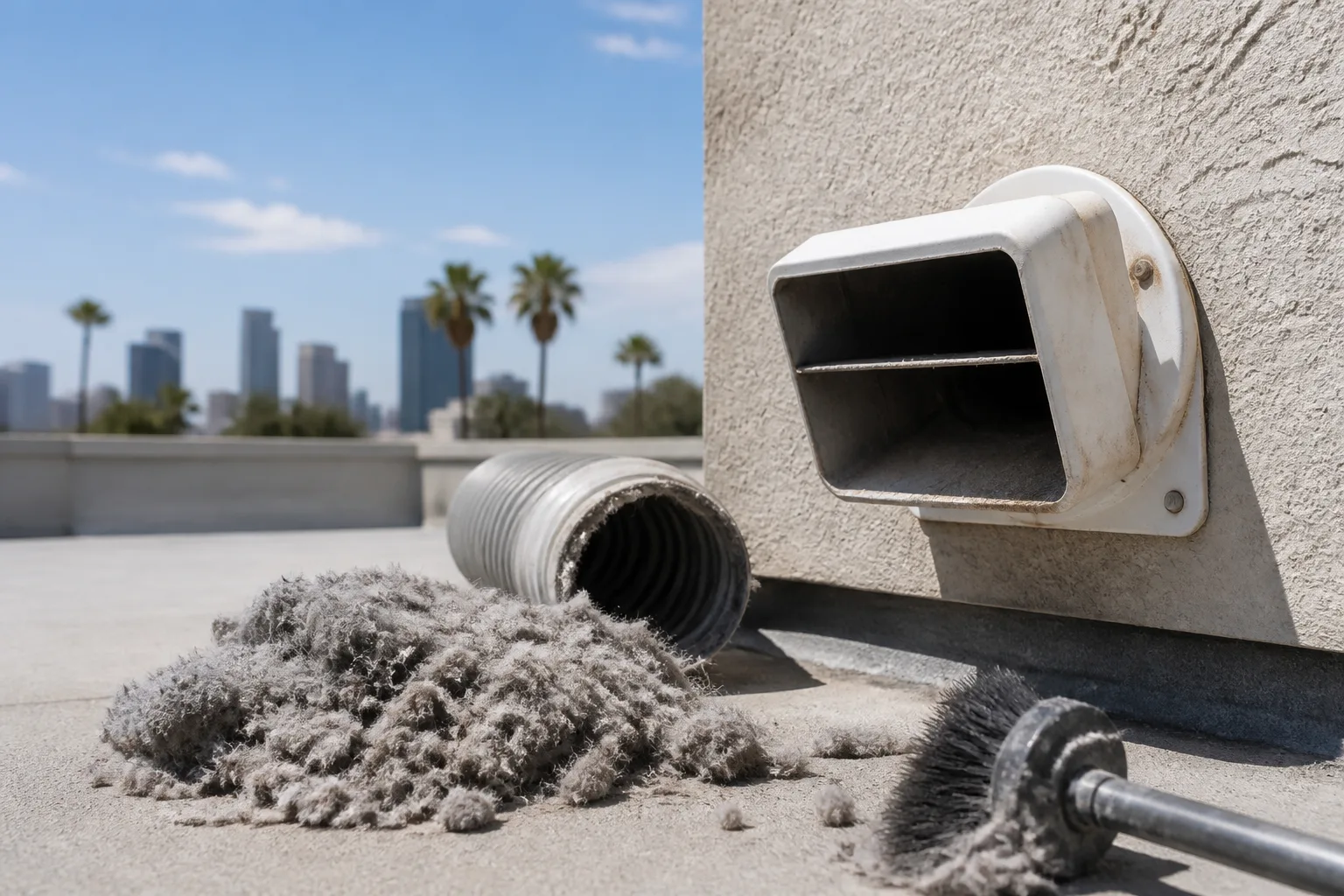
We’ve opened exterior caps in neighborhoods like Mar Vista and Northridge where a homeowner had “cleaned” their vent a month earlier. Behind the cap sat a hard, spongy wad of lint the size of a softball, dry as kindling and sitting within inches of the outside air. The proper sequence is to work from both ends: loosen debris from the interior access point, then pull from the exterior cap with negative-pressure extraction so the debris actually exits the system rather than piling up at the end of the run. Skipping the exterior-end work is the single most common reason a vent reads as “clean” but still has poor airflow.
Mistake #2: Using a Leaf Blower Instead of a Rotary Brush System
A leaf blower moves air, and moving air will push loose lint out of a straight, short vent. Most Los Angeles vents are neither short nor straight. Over time, dryer lint mixed with humidity from the dryer’s exhaust cycle forms a hard, almost felted layer that adheres to the inside of the duct wall. Air alone, no matter how forcefully it’s blowing, will not break that bond.
This is where a rotary brush system, like the professional-grade equipment we run from Rotobrush and Nikro, makes the difference. The spinning nylon or polypropylene brush physically scrubs the duct walls while negative-pressure extraction pulls the dislodged material out simultaneously. It’s the difference between rinsing a baking pan with the faucet versus actually scrubbing it with a brush. We’ve seen vents in the Valley and on the Westside where a homeowner’s leaf blower treatment was followed four months later by a complete blockage, because the blow-through left the hardened layer intact and lint began adhering to it again the very next load. On a long vent run, high static pressure also forces a leaf blower to work against itself: the air loses velocity around each bend, so the furthest reaches get almost nothing.
Related Services in Los Angeles
If you’re having recurring lint buildup even after cleaning, the issue may be a damaged or poorly routed vent line. Our Dryer Vent Cleaning in Los Angeles service includes a full inspection of the vent run, and if the duct needs repair or re-routing, our Air Duct Repair in Los Angeles team handles it with a written guarantee on every repair. Need the full HVAC system done too? See our Air Duct Cleaning in Los Angeles page for details.
What happens when you call
- 1
A real person answersNo phone trees - you reach a local pro.
- 2
You get an upfront price rangeHonest numbers before anyone is dispatched.
- 3
A background-checked tech heads outLicensed & insured, dispatched right away.
- 4
You approve before work beginsNothing starts until you say go.
Mistake #3: Ignoring a Crushed or Kinked Flexible Duct Section
Flexible foil or semi-rigid duct is common in Los Angeles laundry rooms, especially in older homes where the dryer sits against an exterior wall or in a hallway closet. The problem is that flex duct is fragile. A dryer pushed back against the wall can crush the duct behind it. A duct run through a cabinet cavity can get kinked at a tight bend. A rodent in a crawlspace can chew through the foil. Any of these reduces the interior diameter from four inches to maybe an inch and a half, which means the dryer has to work harder to push air through a space half the size it needs.
Here’s the critical sequence point: if you clean a crushed duct without fixing the crush first, you have not solved the underlying restriction. Airflow remains poor, the dryer still runs hot, and lint will begin accumulating at the pinch point within weeks. The correct order is inspect, repair, then clean. A proper technician will check the entire run for kinks, sags, the use of tape instead of proper clamps, and any sagging sections where condensation and lint pool together. Replacing a damaged flex section with rigid or semi-rigid duct is not a huge job, but it has to happen before the cleaning, not after. We will not clean a vent without checking this first, because doing it backwards simply wastes your money.
Mistake #4: Skipping the Airflow CFM Test at the Exterior Cap
Visual inspection tells you what you can see. Airflow measurement tells you what’s actually happening inside the system. A cubic-feet-per-minute (CFM) reading at the exterior cap measures the actual volume of air exiting the vent while the dryer runs. Most manufacturers recommend a maximum equivalent duct length of 25 to 35 feet, with each 90-degree bend counting as five feet of equivalent length. A long vent run in a Los Angeles townhome or a second-floor laundry room can easily exceed that, and the CFM reading will show it.
We use an anemometer or a digital manometer at the cap to measure this. A weak reading on a vent that looks clean usually means there’s a hidden restriction somewhere in the middle of the run: a disconnected joint, a section that’s come loose from its hanger and is sagging full of water and lint, or a bird’s nest in the cap itself. None of those are visible from either end. In our experience, this test catches the sort of problem homeowners call us about a second time, after a cheaper company cleaned the vent and pronounced it done without ever measuring airflow. If the CFM reading is still low after the cleaning, the job is not finished. That’s the standard we hold.
Mistake #5: Scheduling Dryer Vent Cleaning as an Add-On to HVAC Duct Cleaning
This one surprises people, because booking both at once sounds efficient. And from a scheduling standpoint, it is efficient. The practical problem is that the two systems share nothing but the word “duct.” Your HVAC air ducts circulate conditioned air through your living space. Your dryer vent expels hot, moisture-laden air and lint directly to the exterior. The tools, the access points, and the cleaning protocols are all different.
When a company runs both jobs back-to-back in the same visit, the technician is usually thinking about the next appointment, not about doing the dryer vent to a different standard. The dryer vent typically gets a quick brush-through or vacuum that misses exactly the kinds of problems we’ve described above: compacted lint at the exterior cap, hidden restrictions mid-run, or a crushed flex section behind the dryer. We’ve been doing this, and we long ago decided to keep dryer vent cleaning as its own dedicated service call. It takes the time it takes. The vent gets thoroughly cleaned, the airflow gets measured, and the customer gets a clear picture of what was done. If you’re booking both services, that’s fine, but make sure each job gets its own time and its own written scope of work.
When to Call a Pro
You can clean the lint trap in your dryer after every load, and you should. That’s the single best thing a homeowner can do. But the vent line itself is a different animal. If your vent run is longer than about ten feet, has any bends, passes through a wall, ceiling, or crawlspace, or if it’s been more than a year since the last professional cleaning, get a trained technician with the right equipment to do the full job. This is also not the place for aggressive DIY: reaching into a vent with a metal rod or improvising with a power tool can puncture the duct, disconnect a joint, or push a blockage further out of reach.
For what it’s worth, we also recommend looking for a technician who can verify their work, not just claim it. Ask for before-and-after photos of your actual vent surfaces. Ask for the CFM reading at the cap. Ask what happens if the vent clogs again within a year. Our answers: photos of every job, the airflow number before and after, and our Linden Air Duct Cleaning home service standard, which includes the Done Right Promise. If the work is not right, we make it right, in writing, on every job.
The Bottom Line
The five mistakes that cause most dryer vent cleaning failures in Los Angeles are: cleaning only from the interior end, using a leaf blower or shop vac instead of a rotary brush, ignoring a crushed or kinked duct section, skipping the airflow measurement at the exterior cap, and lumping dryer vent cleaning in with HVAC duct cleaning without giving it proper time and attention. Every one of these leaves lint in the vent system, and each of them can make the next cleaning harder.
If you’re in Los Angeles and want the job done once, correctly, with proof when it’s finished, call Linden Air Duct Cleaning at (980) 447-2498. Estimates are free, the price is in writing before we start, and every technician arrives background-checked, identity-verified, and introduced to you by name and photo before the visit. That’s the Threshold Standard, and it’s been our operating procedure.
Frequently Asked Questions
Most households in Los Angeles should have the dryer vent professionally cleaned once a year, assuming normal use of four to six loads per week. If you have a long vent run, multiple 90-degree bends, a second-floor laundry room, or if you dry heavy items like blankets and dog beds regularly, every six months is safer. The best test is this: if the dryer is taking longer than about 45 minutes to dry a normal load, or if the exterior of the dryer gets hot to the touch during a cycle, the vent is likely restricted. Call (980) 447-2498 and we’ll tell you over the phone whether a cleaning makes sense.
Lowball quotes in the vent cleaning world usually mean one of three things: the company plans to clean from one end only, they’re not planning to measure airflow, or the quote is a teaser price that will grow after the technician arrives and “discovers” extra work. A proper cleaning uses rotary brush agitation and negative-pressure extraction from both ends, includes a CFM airflow test, and ends with before-and-after photos. That takes time and real equipment. You are not paying for the brush; you’re paying for the verification that the job actually worked. Get the price in writing before the technician arrives, every time.
Ask for three things: before-and-after photos of the interior surfaces of your vent duct, the CFM airflow reading at the exterior cap before and after the cleaning, and a written summary of what was found and what was done. If a company can’t or won’t provide those, you have no way to verify the work. This is standard practice for our technicians in every Los Angeles home, and it’s documented on the invoice. The Done Right Promise covers you if anything is not right after the cleaning.
You can do a partial job with a vacuum and a flexible brush kit from a hardware store, if your vent is short, straight, and easily accessible from both ends. Most Los Angeles homes don’t fit that description. For any vent over ten feet, any run with bends, or any vent that exits through a wall or roof, a professional-grade rotary brush with negative-pressure extraction is the right tool, and that’s not something most homeowners have in the garage. If you’re unsure, call us and describe your setup. We’ll give you an honest answer about whether it’s worth hiring someone or doing it yourself.
Written by the team at Linden Air Duct Cleaning.
Need Air Duct Cleaning Help?
Call Linden Air Duct Cleaning - licensed & insured, here with fast after-hours help in Los Angeles.
(980) 447-2498