
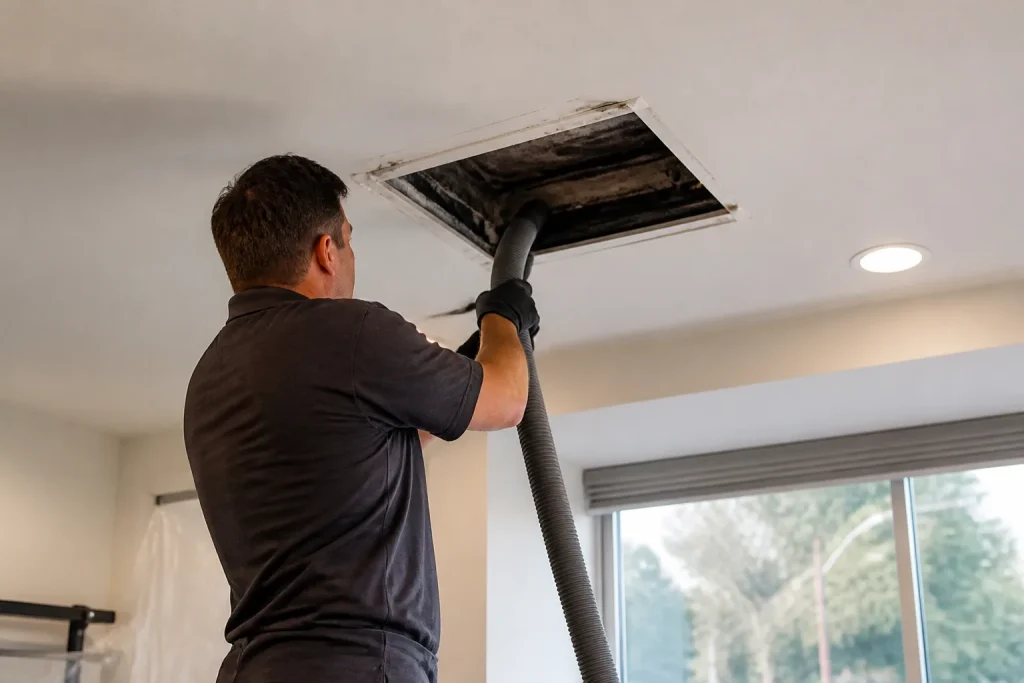
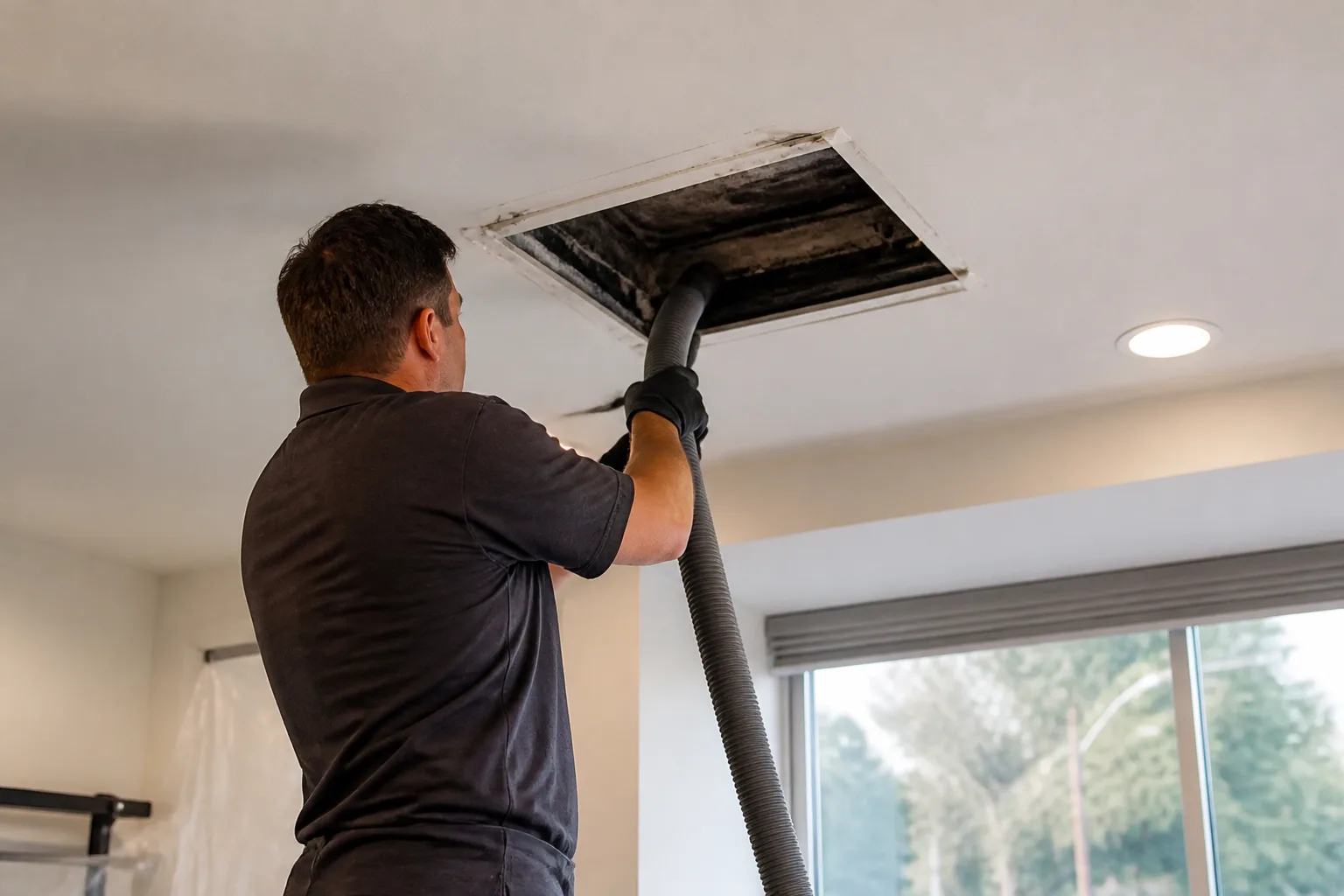
Air Duct Repair: Repair or Replace? How Los Angeles Homeowners Decide
A 6-inch tear in an attic flex duct and a 6-inch tear in a wall-enclosed rigid duct can look identical on a report but require completely different financial decisions. In Los Angeles, the repair-or-replace question usually comes down to three things: where the duct runs, what it’s made of, and whether the access required to fix it makes repair more disruptive and expensive than replacement in the long run. Most contractors won’t walk you through why. We will. If you’d rather skip the reading and talk it through, call (980) 447-2498.
Here’s the honest version: sometimes a $300 repair is the right call. Sometimes a $300 repair is a down payment on a $1,800 replacement six months later. Knowing which is which before you spend a dime is what this guide is for.
The Direct Answer: When Repair Makes Sense, When Replacement Does
Repair is usually the right call when the damaged duct is accessible, the material is still structurally sound, and the failure is isolated. In practical terms: a disconnected flex duct in an open attic, a crushed section of round pipe in an unfinished basement, or a separated joint at a visible register boot. These are localized problems with straightforward fixes that cost between $175 and $500 in the Los Angeles market depending on access difficulty and parts.
Replacement becomes the better financial decision when the ductwork is original to a home built before roughly 1985, when the system has multiple leaks rather than one, when the ducts run through enclosed wall cavities or tight crawlspaces that make access costly, or when the material itself is failing. Galvanized steel ducts from the 1960s and 70s that have rusted at the seams are not worth patching. You will pay $400 to fix a seam today and $500 to fix another seam in eight months. At some point the math stops being a debate.
Why Duct Location Changes the Math Dramatically in Los Angeles
Los Angeles housing stock runs the full gamut: 1920s Spanish-style homes in Silver Lake with original steel ductwork, 1950s Mid-Century ranches in the Valley with undersized round pipe, 1970s two-story tract homes where the supply ducts run through the floor joists between the first and second floor. Each layout presents a different access problem, and access is what really drives labor cost.
An attic-mounted flex duct in a Sherman Oaks home is usually reachable in under an hour. The repair is straightforward: cut the damaged section, install a splice collar, secure with mastic and UL-listed tape, done. $150 to $350 all in. But that same tear in a duct buried inside a wall cavity in an older West Adams home? You’re looking at drywall removal, possibly asbestos testing if the home is pre-1980, duct access that may require cutting through framing, patch and texture work, and repainting. That repair can easily reach $1,200 to $2,000, at which point you’re not comparing it to a repair anymore. You’re comparing it to rerouting or replacing the affected run, which might cost $1,500 to $2,500 and leaves you with new ducting instead of patched old ducting.
Our team has done this exact job in Los Angeles more times than we can count. The crawlspace under a Venice Beach bungalow is a different workplace than the open attic of a Porter Ranch tract home. Crawlspace work means limited headroom, often standing water or pest debris, and labor that moves at half speed. If your damaged duct is in a crawlspace, the repair labor is already expensive. Replacing that section with new insulated flex while we’re in there often costs only marginally more. That’s the kind of math you want before you commit.
The Material Factor: Repairable Steel vs. End-of-Life Steel
Original galvanized steel ducts in older Los Angeles homes present a specific dilemma. When they were new, they were excellent. Sixty years later, the seams are often rusted, the insulation (if there was any) has degraded to nothing, and the joints leak conditioned air into unconditioned space. You can patch a rusted seam, but the metal adjacent to that seam is just as old and just as corroded. We have repaired a seam in a Highland Park home on a Tuesday and returned eight months later to replace a different section that failed. The homeowner paid twice because the material was exhausted, not because the repair was poorly done.
Here’s how to think about it: if your steel ducts are from the 1950s through the 1970s and they’re starting to separate at the longitudinal seams, the system is in the end stage of its service life. Galvanized steel ductwork typically lasts 40 to 50 years in coastal Los Angeles air, less near the beach where salt air accelerates corrosion. If you’re at year 55 and seeing your second or third seam failure, further repairs are throwing good money after bad. Transitioning to modern R-8 insulated flex or new 26-gauge sheet metal with proper mastic-sealed joints will cost more now and cost nothing for the next two decades.
How to Read a Duct Leakage Test Result
If a Los Angeles contractor recommends replacement, ask for a duct leakage test before you agree. The standard is a duct blaster test, which measures exactly how many cubic feet per minute (CFM) of air escapes your duct system at a given pressure. The result gets compared to what a properly sealed system should leak. Here’s the practical guide:
- Less than 10% leakage: Your system is in good shape. Repair the specific failure and move on. Do not accept a replacement recommendation without a specific, photographed explanation of why.
- 10% to 20% leakage: Marginal. If the leak is localized and accessible, repair it. If the leakage is spread across many joints and the ducts are old, replacement becomes a reasonable long-term recommendation.
- Over 20% leakage: On a Los Angeles system that’s 15 or more years old, replacement is usually the right call. You’re losing one-fifth or more of the air you paid to condition. The utility savings alone on a 2,000-square-foot home typically offset a meaningful share of the replacement cost over five to seven years.
A reputable contractor will show you the test results and explain where the leakage is concentrated. A less scrupulous one will simply say “you need all new ducts” without measuring anything. You can tell the difference immediately.
The Hidden Cost of Partial Repairs: When Patching Creates Repeat Calls
One of the most common phone calls we get at Air Duct Repair in Los Angeles goes like this: a homeowner paid another company to patch a torn section of flex duct, and three months later a different section separated at a nearby connection. They think the original patch failed. Usually it didn’t. The real issue is that the original repair never included an inspection of adjacent connections, which were already loose and waiting to separate.
Flex duct in Los Angeles attics fails in predictable ways. The inner plastic liner tears, the insulation sleeve gets compressed or torn by rodents or previous tradespeople, or the connection to the sheet-metal collar at the plenum or register box comes loose. What we often find is that the duct has been stressed along its entire run: not enough support strapping, sharp bends, ducts crushed under boxes of Christmas decorations. Patching the visible failure without checking the rest of that run is half a repair.
This is why our written scope of work always includes inspection of the adjacent duct connections on both sides of any repair. It adds twenty minutes to the job and prevents the second service call. When you’re getting quotes for repair work, ask this exact question: “Does the price include inspecting the connections on both sides of the failure?” If the contractor hesitates, get another quote.
What a Written Scope of Work Must Specify Before Any Repair Begins
In Los Angeles, where the price of a repair can swing wildly based on access, you want everything in writing before the technician starts. The industry has a reputation problem, and most of it comes from verbal agreements that turn into surprise invoices. At Linden Air Duct Cleaning home, our price is written before any work begins. No exceptions. Here’s what the scope should include:
- The exact location of the repair: Not “supply duct, attic” but “6-inch insulated flex duct, attic northwest corner serving master bedroom register.” If the location is too vague to find, the price is too vague to trust.
- The specific work to be performed: “Remove and replace 8-foot section of 6-inch R-6 flex duct; seal both splice connections with mastic and UL 181 tape; re-strap at existing supports.” This is the language of a professional.
- The materials to be used and their R-value: R-6 is the California minimum for residential ductwork; R-8 is better and increasingly standard for attic installations. Make sure the R-value is stated.
- Conditional access language: If the duct is in a wall cavity, the scope should state what happens if additional access is needed: who cuts the drywall, who patches it, and what the additional cost is. If it’s not written, you’re accepting open-ended liability.
- The guarantee in writing: How long the repair is covered and what happens if it fails. Ours is a 365-Day Done Right Promise. If the covered repair doesn’t hold, we come back at no charge. That specific language, in writing, is what you’re looking for.
We pulled a duct out of a crawlspace under a Pasadena home last month where the previous repair consisted of a t-shirt wrapped around a tear and secured with duct tape. Duct tape on ducts is a cruel joke the trades have been telling for decades. The homeowner paid $450 for that repair. It failed within weeks. The written scope had said “repair duct as needed.” That’s not a scope. That’s an open checkbook invitation.
When to Call a Professional for Duct Repair
Air ducts are not a DIY project, and not because the work is always difficult. Some of it isn’t. The problem is that the inside of your duct system is the air you breathe, and poorly done repairs make that air worse. Duct sealant that off-gasses, incorrect insulation that creates condensation inside the duct, mastic smeared into the airflow path: all of these are invisible problems that hurt indoor air quality for years.
Call a professional when the repair requires anything beyond a visible, accessible, simple reconnection. If the duct is in a wall cavity, in a crawlspace, attached to a furnace plenum, or if you have any concern about mold, rodent contamination, or asbestos-containing materials in an older Los Angeles home, bring in a trained person. The repair cost is insignificant compared to what a botched job costs in air quality and evaporation of home value. Also call a professional for anything related to older galvanized systems under tension or pressure from the HVAC blower: those systems need proper static pressure, and a well-meaning patch can unbalance the airflow and strain the blower motor.
Related services in Los Angeles: if the duct inspection reveals debris, pet hair, or construction dust built up in the system, our Air Duct Cleaning in Los Angeles service uses negative-pressure extraction to remove it. And while we’re in the home, Dryer Vent Cleaning in Los Angeles is worth considering whenever we find lint bypassing the trap and collecting inside the exhaust duct.
The Bottom Line
Repair or replace in Los Angeles is a math problem, not a guess. If the duct is accessible, the material is sound, and the failure is isolated, a repair between $175 and $500 is your best call. If the duct is inaccessible, the material is at or near the end of its service life, or the leakage test shows the whole system is bleeding air, replacement stops being the expensive option and becomes the only option that doesn’t repeat itself. Get everything in writing. If a contractor can’t tell you exactly what they’re doing, exactly what it costs, and exactly what happens if it fails, keep looking.
If you’re in Los Angeles and want a straight answer about your ductwork, we’re the people to call. Linden Air Duct Cleaning gives you a written price before any work begins, a written guarantee on every repair, and a tech whose name and photo arrive before the visit. Call (980) 447-2498 for a free estimate. A live person answers, any hour, any day.
Frequently Asked Questions
Most air duct repairs in Los Angeles cost between $175 and $500 for accessible, localized failures like a disconnected flex duct in an open attic. Repairs that require drywall access, crawlspace work, or wall-cavity access typically run $1,200 to $2,000. Full replacement of a home’s duct system in Los Angeles usually costs between $1,800 and $4,500 depending on square footage, number of runs, and access difficulty. Call (980) 447-2498 for an exact quote on your specific system. Estimates are free.
Ask for a duct leakage test. If leakage is under 10%, repair the specific failure. Between 10% and 20%, the answer depends on the age and accessibility of your ducts. Over 20% leakage on a system that’s 15 or more years old means replacement is usually the smarter long-term financial decision. Any contractor recommending full replacement should be able to show you test results and specific failure points, not just make a verbal recommendation.
Cheap quotes usually mean one of three things: the work isn’t specified in writing, the technician isn’t properly trained or verified, or the quote is a loss leader designed to get a technician into your home so they can find “additional issues” once the repair begins. Reputable Los Angeles duct repair companies put the price, the scope, and the guarantee in writing before work starts. If the quote is vague about what you’re actually getting, the final invoice usually isn’t.
A properly done repair on sound ductwork should last the remaining life of the duct system, generally 10 to 20 years for modern flex or sheet metal, provided the adjacent connections are also inspected and secured. If a repair fails within months, it usually means the surrounding ductwork wasn’t checked, the wrong materials were used, or the underlying system was already failing. Reputable Los Angeles contractors back their repairs in writing. Our repair guarantee is 365 days with a free return visit if the covered repair doesn’t hold. Call (980) 447-2498 to talk through your situation.
Written by Marcus Veale, Owner at Linden Air Duct Cleaning, serving Los Angeles since 2004.
Need Air Duct Cleaning Help?
Call Linden Air Duct Cleaning - licensed & insured, here with fast after-hours help in Los Angeles.
(980) 447-2498