
Preparing Your Home’s Air Duct Cleaning for Winter in Los Angeles
Here’s the straight answer: before you fire up the heater this November, you should have your ducts inspected and, in most cases, cleaned. In Los Angeles, our heating systems sit idle from roughly March through October, and that’s the problem. Warm attic air, dust from Santa Anas, and leftover wildfire particulate settle into ductwork and stay there, undisturbed, until the first cold snap pushes it all through your vents at once.
Most LA homeowners don’t realize their ducts are dirtier than a Minneapolis home’s, even though we run our furnaces a fraction as often. The stagnation is the issue. We’ll walk through exactly what to check, when to schedule, and what it should cost, and if you’d rather not DIY any of this, call (980) 447-2498 and we’ll talk you through it.
Why Los Angeles Ducts Get Dirtier Sitting Idle Than Cold-Climate Ducts Do Running Daily
In Chicago or Boston, a furnace runs hundreds of hours each winter. That constant airflow acts like a river: it keeps finer particles moving toward the filter and gives homeowners an early warning when something smells off. You notice a musty odor in January because the system runs every day.
Los Angeles is different. The average LA home logs fewer than 1,200 heating degree days per year, compared to 6,000-plus in the upper Midwest. Translation: our furnaces barely run. That means the air inside your ducts is still for eight or nine months straight. No airflow, no filter cycling, no signal that anything’s wrong. Meanwhile, dust settles, pet dander accumulates, and the warm, low-ventilation environment inside an LA attic is exactly where biological growth likes to take hold. By the time you flip the thermostat on in late November, everything that’s been sitting in there gets aerosolized in the first few cycles.
We’ve pulled a dust mat out of a duct run in a Valley Glen home that measured nearly three-quarters of an inch thick. The homeowner was meticulous about changing filters. The system just hadn’t moved any air in months. That’s a Los Angeles problem, not a housekeeping one.
The Pre-Winter Inspection Sequence: Four Things to Check Before You Book a Cleaning
Before you spend money on duct cleaning, there’s a specific order of operations we recommend to every Los Angeles homeowner. Skipping steps wastes money. Here’s the sequence.
1. Check the filter first. If your filter is clogged, the system isn’t circulating air properly, which means it’s not distributing whatever’s in the ducts anyway. Replace it, then wait a full heating cycle. A clean filter is the baseline.
2. Inspect the registers. Remove a supply vent cover in a main living area. Look at the inside walls of the register boot with a flashlight. If you see gray or black streaks, dust buildup, or what looks like fuzz, that’s visible confirmation of what’s deeper in the system, not just a dirty vent cover.
3. Check the blower compartment. This step matters in Los Angeles because of how often the system sits idle. Dust on the blower wheel itself means particles are being pulled in from somewhere, usually the return side. If the blower is coated, cleaning the ducts without addressing the blower will just re-contaminate the system within weeks.
4. Look inside the duct runs. Only after steps one through three make sense. If you can access an attic or crawlspace section of ductwork, remove a section joint or check through a vent opening. What you’re looking for is accumulation on the duct walls, not just loose dust.
The reason we recommend this order is practical: if your blower motor is failing or your filter housing is leaking, cleaning the ducts first is like vacuuming a room with the windows open during a dust storm. You’ll pay for a service that won’t hold. We’ve turned down duct cleaning jobs in Los Angeles where the real issue was a cracked return plenum pulling attic air. It’s not about selling less, it’s about fixing the actual problem.
Wildfire Smoke Residue: Why This Winter’s Ducts Need a Different Approach
Los Angeles homeowners who live anywhere near the foothills or the 405 corridor know what September and October bring. The past few fire seasons have deposited a fine, oily particulate into attic spaces that standard dust doesn’t resemble at all.
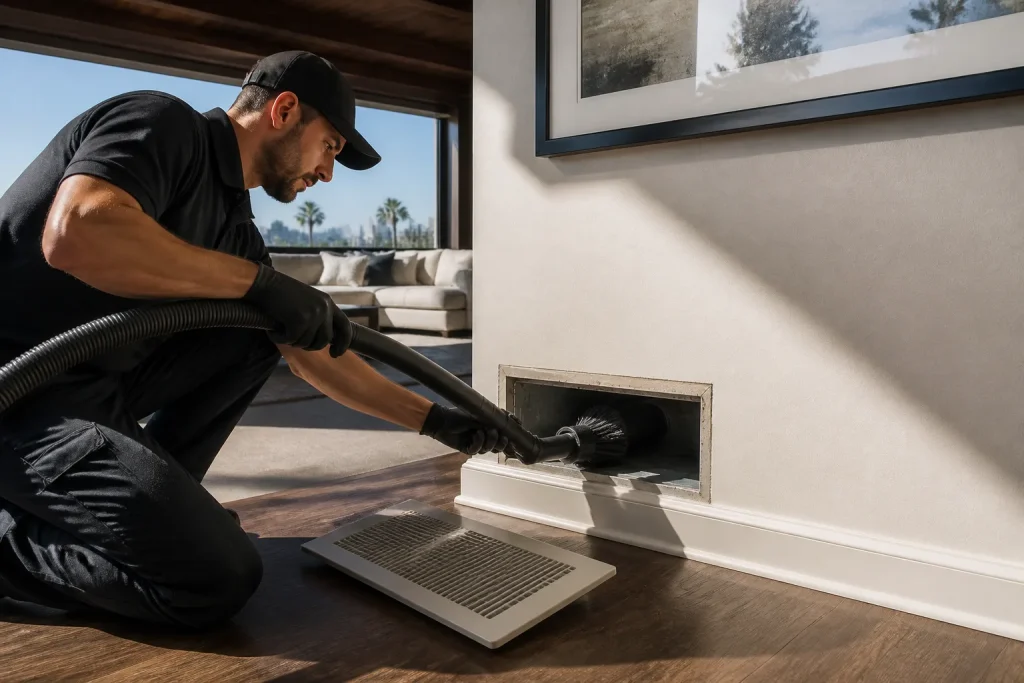
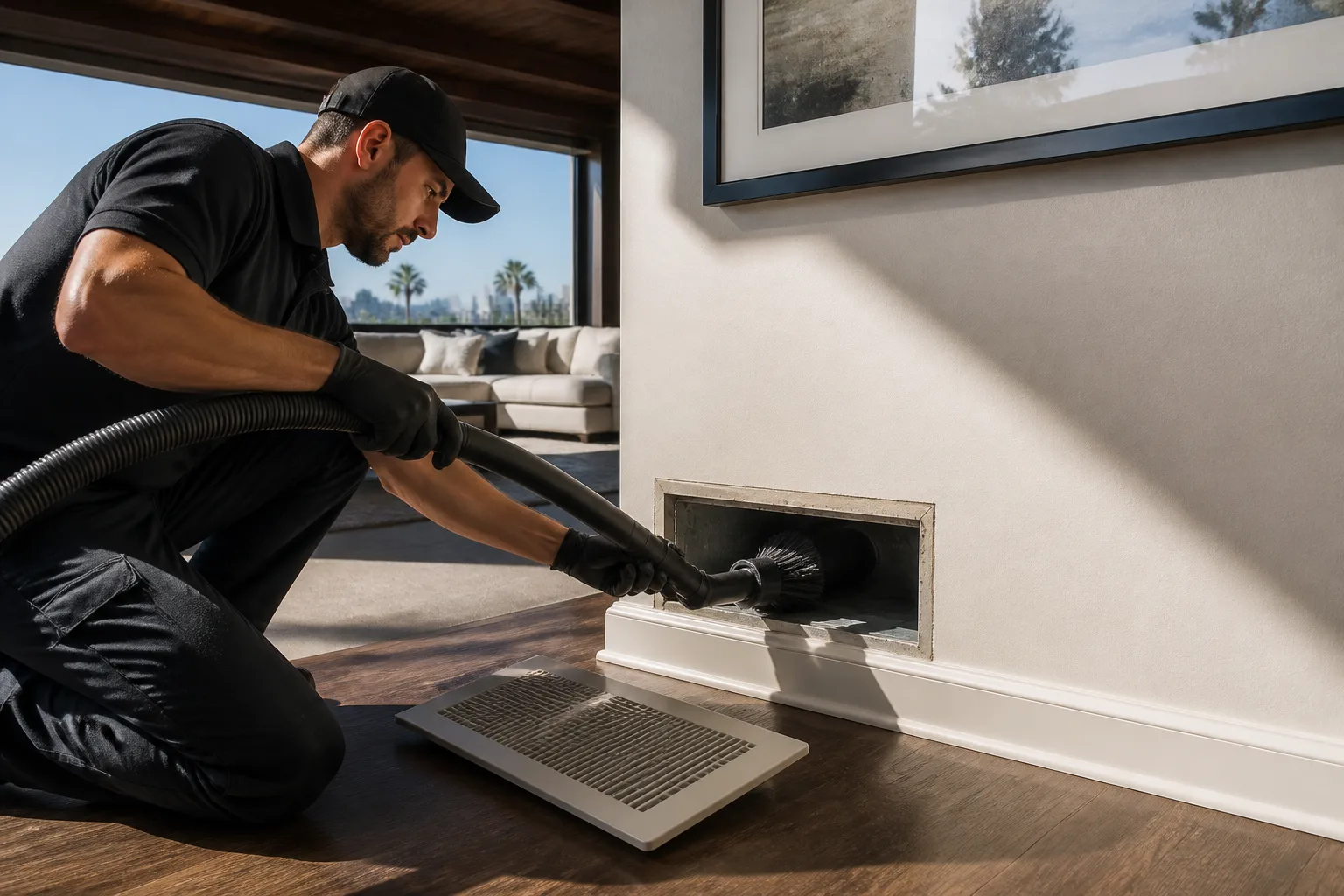
Wildfire smoke particulate behaves differently inside ductwork. Regular household dust is mostly skin cells, fiber, and dirt: light, dry, and easy to extract with standard negative-pressure equipment. Smoke residue is finer, stickier, and often contains combustion byproducts that adhere to duct walls and can linger as an odor. If your Los Angeles home was downwind of a burn zone at any point in the last six months, a standard “air washing” pass won’t remove what’s bonded to the surfaces. It requires a more deliberate approach: detailed surface agitation, longer extraction cycles, and sometimes a dry-application antimicrobial treatment designed for HVAC interiors.
This is also where equipment matters. We run Rotobrush and Nikro systems on our trucks because they’re built for exactly this kind of detailed wall agitation, not just pulling air through a hose. The right equipment paired with the right technique is the difference between ducts that look clean and ducts that actually are.
Testing Your System Before You Book: Don’t Clean Ducts That Have a Bigger Problem
Before scheduling a cleaning, do this twenty-minute test. It tells you whether the blower and distribution are working, which rules out the possibility that poor airflow is being mistaken for dirty ducts.
- Turn the fan to “on” (not auto) at the thermostat and set it to circulate. Stand near a supply register in the farthest room from the furnace.
- Hold a tissue or a single square of toilet paper a few inches from the vent. It should move noticeably. Not flutter wildly, but a clear, steady push.
- Repeat in three rooms. Is airflow noticeably weaker in one room or one side of the house? That could be a collapsed duct, a disconnected run, or a damper issue, not buildup.
- Turn the system off and listen. Any rattling, metallic scraping, or a hollow thumping when it winds down usually points to the blower wheel or motor, not the ducts themselves.
If the airflow is weak in one zone, a cleaning won’t solve it. Duct cleaning addresses contamination, not mechanical failure. A good Los Angeles duct company will tell you this upfront. A less honest one will clean your ducts, charge you for it, and leave the airflow problem exactly where it was. That’s why we put everything in writing before starting, including what the work does and doesn’t cover, using our Linden Air Duct Cleaning home verification process.
When to Schedule in Los Angeles: September Through October Is the Window
There’s an actual logistical reason to clean your ducts in September or October, beyond just having it done before winter. Summer in Los Angeles is hot, dry, and dusty. Santa Ana winds kick up fine particulate. Wildfire smoke peaks in late summer. All of that settles into your ductwork by early fall. If you clean in September or October, you’re starting the heating season with a system that’s as clean as it’s going to get, before winter moisture and colder nights introduce any new variables.
Waiting until January means you’ve already run the heater for six to eight weeks, which means you’ve already distributed whatever was sitting in the ducts during those idle months. The damage, in terms of air quality, is already done by then.
We also recommend September and October for practical scheduling reasons. Los Angeles duct companies get busier in late fall when everyone notices the furnace smell. Booking in the late-summer lull means you’re more likely to get a confirmed appointment in writing, not a vague “we’ll put you on the list.” At Linden, you’ll get a specific date and time window, the technician’s name and photo before the visit, and the price in writing before anything happens. That’s not a premium service, it’s how the Air Duct Cleaning in Los Angeles process should work every time.
What a Proper Winter Prep Cleaning Actually Costs in Los Angeles
Let’s talk numbers, because this is where homeowners get taken advantage of. In Los Angeles, a legitimate whole-system duct cleaning for a typical single-family home runs between $450 and $1,100. The range depends on the size of the home, the number of systems, the level of contamination, and whether the ducts are rigid metal or flexible. If you see a coupon for a $99 whole-house duct cleaning, that’s a bait price. The technician who shows up will find reasons to add on. You’ll pay more than the honest quote would’ve been in the first place.
| Scope | Typical Los Angeles Range |
|---|---|
| Single system, up to 12 vents | $450 – $650 |
| Single system, 12-20 vents, moderate debris | $600 – $850 |
| Two systems (upstairs/downstairs) | $800 – $1,100 |
| Heavy contamination or wildfire smoke remediation | $950 – $1,400 |
Every quote we give at Linden Air Duct Cleaning is one flat price per system, written down before work begins. No per-vent pricing, no surprise invoices. The 365-Day Done Right Promise covers the work, in writing, and if a repair we make doesn’t hold, we come back at no charge. If you’re considering Air Duct Repair in Los Angeles, that guarantee applies there too.
And before you ask: no, your ducts probably don’t need to be cleaned every year. In a typical Los Angeles home with a good filter, every three to five years is reasonable. If you’ve had construction, a rodent issue, or significant wildfire smoke exposure, that timeline changes. That’s what the inspection sequence above is for, to figure out whether this is the year.
The Bottom Line
Preparing your air ducts for winter in Los Angeles isn’t about following a generic maintenance checklist. It’s about understanding that our climate creates a specific problem: long idle periods that allow debris to accumulate silently, followed by a sudden blast of that debris when the heat first cycles on. The solution is an inspection in the right order, a cleaning scheduled for September or October, and a company that puts its pricing and its guarantees in writing before anyone touches your system.
During the winter prep season in Los Angeles, we also remind homeowners about Dryer Vent Cleaning in Los Angeles, since a clogged dryer vent is the leading cause of house fires caused by dryers. The same cold-season transition that wakes up your furnace also means more dryers running with windows closed and less ventilation. It’s worth checking both.
If you’re in Los Angeles and want a free estimate, call (980) 447-2498. A live person answers. You’ll get a written price before any work begins, and the technician’s name and photo before they ring your doorbell.
Frequently Asked Questions
September or October is the right window in Los Angeles. This allows you to remove dust, wildfire smoke residue, and biological growth that accumulated during the long idle period before the heater starts cycling in November. By cleaning before the heating season begins, you’re preventing that accumulated debris from being distributed through your home on the first cold snap. Call (980) 447-2498 for a written, confirmed appointment. We don’t do vague callbacks, and our estimates are free.
Start with a visual inspection of the registers, the blower compartment, and an accessible section of ductwork. Use a flashlight. If you see gray or black streaks, dust buildup on the blower wheel, or accumulation on the duct walls, the system has contamination that will circulate when the heat turns on. Weak airflow in one zone is often a mechanical issue rather than a cleanliness one, and a good Los Angeles duct company will tell you the difference before quoting a cleaning job. If you’d rather have a trained set of eyes on it, call (980) 447-2498.
Because those low quoted prices are designed to get a technician in the door, not to clean your ducts thoroughly. A legitimate whole-house cleaning in Los Angeles runs $450 to $1,100 for a typical single-family home. The $99 coupon price is a baited hook, and the final invoice after add-ons usually lands higher than an honest upfront quote would have been. At Linden Air Duct Cleaning, every quote is one flat price per system, written before any work begins. No per-vent pricing, no surprise charges. Call (980) 447-2498 for a straight answer.
Yes, smoke residue is finer, stickier, and more likely to hold odor than standard household dust, and it requires surface agitation, not just suction. In Los Angeles, where several recent fire seasons have deposited heavy particulate into attic spaces, a standard air-wash pass often isn’t enough. The equipment used matters: we run Rotobrush and Nikro systems specifically because they’re engineered for detailed wall contact rather than simple negative-pressure extraction. If your home was downwind of a burn zone in the last year, mention that when you call (980) 447-2498 so we can schedule the right kind of job.
Written by Marcus Veale, Owner at Linden Air Duct Cleaning, serving Los Angeles since 2004.
Need Air Duct Cleaning Help?
Call Linden Air Duct Cleaning - licensed & insured, here with fast after-hours help in Los Angeles.
(980) 447-2498